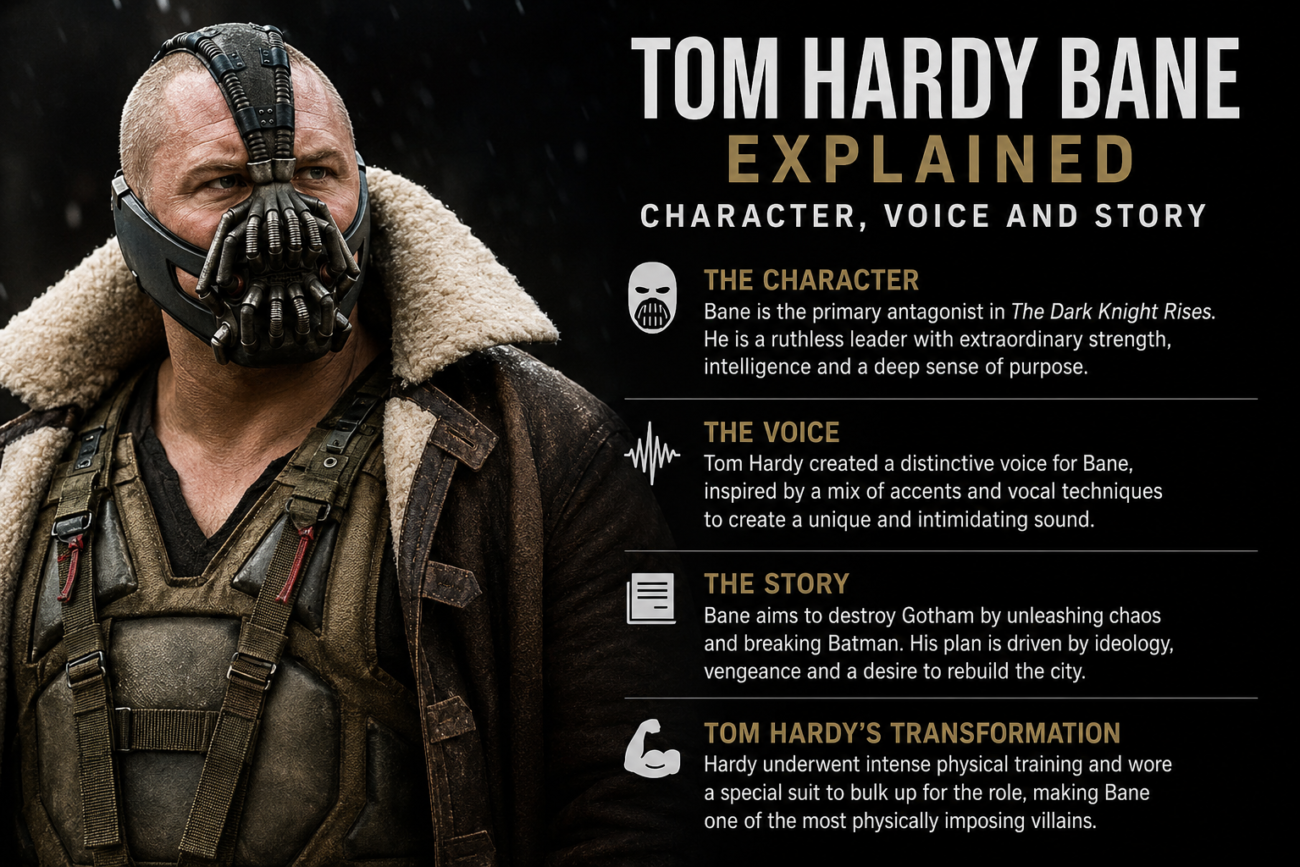
Tom Hardy’s portrayal of Bane in The Dark Knight Rises remains one of the most discussed performances in Christopher Nolan’s Batman trilogy. Hardy took a character already known to comic-book fans and transformed him into a physically imposing, highly intelligent, and unusually controlled villain.
The Tom Hardy Bane performance stands out for more than the character’s size and intimidating appearance. Hardy developed a distinctive voice, movement style, physical presence, and emotional restraint that made Bane feel different from previous versions of the character.
But who exactly is Bane, what is his role in The Dark Knight Rises, and why does Tom Hardy’s interpretation remain so memorable? This guide explains the character, Hardy’s transformation, Bane’s voice, his relationship with Batman, and the story behind the performance.
Key Takeaways
- Tom Hardy played Bane in Christopher Nolan’s 2012 film The Dark Knight Rises.
- Hardy transformed his physique and movement to create Bane’s imposing physical presence.
- Bane is portrayed as both a powerful fighter and a strategic, intelligent revolutionary.
- His distinctive voice became one of the most recognizable elements of Hardy’s performance.
- Bane serves as the principal physical and ideological opponent to Christian Bale’s Batman.
- Hardy’s version combines elements from the Batman comics with Nolan’s more realistic interpretation of Gotham.
Biography Table
| Detail | Information |
|---|---|
| Full Name | Edward Thomas Hardy |
| Date of Birth | September 15, 1977 |
| Age | 48 as of August 2026 |
| Birthplace | London, England |
| Nationality | British |
| Profession | Actor, producer |
| Education | Drama Centre London |
| Years Active | 2001–present |
| Known For | The Dark Knight Rises, Mad Max: Fury Road, Venom, Inception, Peaky Blinders |
| Major Achievements | Academy Award nomination and numerous film and television awards and nominations |
Who Is Tom Hardy’s Bane?
Bane is the primary antagonist of The Dark Knight Rises, the third and final film in Christopher Nolan’s Batman trilogy.
Played by Tom Hardy, Bane arrives in Gotham City as the leader of a highly organized revolutionary movement. Unlike a conventional criminal, he combines military discipline, physical strength, strategic planning, and political manipulation.
His objective is not simply to defeat Batman. Bane wants to take control of Gotham and create the conditions for the city’s existing social and political structure to collapse.
This makes him a particularly dangerous opponent for Bruce Wayne. Batman has faced enemies who rely on intelligence, technology, fear, or chaos, but Bane combines several of those qualities with extraordinary physical strength.
Bane’s Role in The Dark Knight Rises
At the beginning of the film, Bane operates outside Gotham while preparing a carefully planned takeover.
His organization infiltrates the city and eventually helps him isolate Gotham from the outside world. The resulting situation allows Bane to present himself as a revolutionary figure while maintaining control through fear and force.
His plan also has a personal dimension because defeating Batman is an important part of his strategy.
Bane understands that Bruce Wayne is physically and psychologically vulnerable after years of fighting crime. Rather than immediately treating Batman as an unbeatable superhero, he studies his opponent and exploits his weaknesses.
Tom Hardy’s Transformation Into Bane
One of the most recognizable aspects of the Tom Hardy Bane portrayal is the actor’s physical transformation.
Hardy was already known for physically demanding roles, but Bane required a particularly imposing appearance. The character needed to look capable of overpowering Batman in direct combat.
Hardy’s preparation involved significant physical training and a substantial change in his physique.
Building Bane’s Physical Presence
The goal was not simply to make Hardy look muscular. Bane needed to appear heavier, stronger, and more intimidating than an ordinary fighter.
Hardy’s performance therefore relied on several elements:
- Increased muscularity
- A broader physical silhouette
- Controlled posture
- Deliberate movements
- Powerful fighting techniques
- Restrained facial expressions
- Confident body language
These details helped distinguish Bane from other villains in the Batman series.
Why Bane Looks So Different From Tom Hardy
Costume and makeup also played important roles.
Bane wears heavy clothing and protective equipment that enhances his already powerful silhouette. His mask is particularly important because it covers much of Hardy’s face.
Since viewers cannot rely on conventional facial expressions, Hardy had to communicate much of Bane’s personality through his eyes, posture, gestures, and voice.
That limitation ultimately became an important part of the character’s identity.
Tom Hardy Bane Voice Explained
Bane’s voice is arguably the most recognizable element of Tom Hardy’s performance.
Hardy adopted a distinctive vocal style that sounds controlled, theatrical, and unusual compared with the voices of most movie villains.
The voice is not simply intended to sound threatening. It contributes to Bane’s characterization as someone who believes he is intellectually and morally superior to the people around him.
Why Does Bane Speak That Way?
Bane’s voice helps separate him from his physical appearance.
Visually, he is presented as a massive and intimidating fighter. His voice, however, can sound surprisingly refined and deliberate.
That contrast creates an unusual effect.
Instead of constantly shouting, Bane often speaks calmly while discussing violence, politics, philosophy, or his plans for Gotham. His controlled delivery makes his threats feel calculated rather than impulsive.
The Importance of the Mask
Bane’s mask is part of the explanation for his unusual vocal presentation.
Within the story, the mask is essential to his survival because it provides a continuous supply of medication to manage severe injuries he suffered earlier in his life.
The mask also became an essential visual symbol of the character.
It conceals Hardy’s face while making his voice even more important to the audience’s understanding of Bane.
Bane’s Relationship With Batman
Bane is one of the few villains in Nolan’s trilogy who can challenge Batman physically on almost equal terms.
Their first major confrontation demonstrates just how dangerous Bane is.
Batman expects to use his combat experience against Bane, but Bane has studied him carefully. He understands Batman’s fighting style and recognizes that Bruce Wayne has become physically and emotionally weakened.
The confrontation therefore becomes more than a simple superhero fight.
It represents a clash between two highly disciplined men who have prepared for conflict in very different ways.
How Bane Defeats Batman
Bane’s victory over Batman is important because it completely changes the balance of power in the film.
Batman has spent years believing that determination and preparation can overcome almost any opponent. Bane challenges that assumption.
He defeats Batman through a combination of:
- Physical strength
- Combat skill
- Tactical preparation
- Psychological pressure
- Knowledge of Batman’s limitations
The defeat leaves Bruce Wayne broken and imprisoned, forcing him to reconsider what Batman actually represents.
Bane’s Character and Personality
Bane is more complicated than a stereotypical muscle-bound villain.
His physical strength is obvious, but his intelligence is equally important to the character.
He can organize large groups, manipulate public perception, understand military strategy, and exploit the weaknesses of his opponents.
Bane Is More Than a Fighter
Several characteristics define Hardy’s interpretation of Bane:
Intelligence
Bane is a strategic thinker. He rarely appears to act without purpose.
Discipline
His behavior is generally controlled. Even when he commits acts of extreme violence, he often appears deliberate rather than emotionally overwhelmed.
Physical Strength
Bane’s physical power makes him one of Batman’s most formidable opponents.
Leadership
He commands a large organization and successfully coordinates a complex campaign against Gotham.
Ideological Conviction
Bane presents himself as someone delivering Gotham from corruption and inequality, although his actions reveal a much darker objective.
Bane and the League of Shadows
Bane’s connection to the League of Shadows is one of the most important elements of The Dark Knight Rises.
The League of Shadows was previously associated with Ra’s al Ghul, Batman’s mentor-turned-enemy from Batman Begins.
Bane is connected to the League through his history with its leader and its philosophy of destroying societies that the organization considers corrupt.
This connection gives Bane a broader purpose beyond simply defeating Batman.
He is part of a larger ideological conflict involving Gotham’s future and Bruce Wayne’s legacy.
Bane’s Connection to Talia al Ghul
One of the film’s major revelations concerns Bane’s relationship with Talia al Ghul.
Talia is revealed to be the child of Ra’s al Ghul and a key figure behind the plan against Gotham.
Bane’s relationship with Talia adds another layer to his character. Although he initially appears to be the central mastermind, the story eventually reveals that his role is closely connected to Talia’s personal mission and her father’s legacy.
This twist also changes how viewers understand several earlier events in the film.
Bane’s Costume and Mask
Bane’s costume is one of the most recognizable villain designs in Nolan’s trilogy.
His appearance combines practical clothing with protective equipment and his signature mask.
The design avoids making him look like a traditional comic-book superhero villain. Instead, it fits Nolan’s grounded visual style.
The mask is especially significant because it creates an immediate silhouette that audiences can recognize even from a distance.
Why the Mask Matters
The mask serves several purposes:
- It reflects Bane’s physical condition.
- It provides a distinctive visual identity.
- It reinforces the mystery surrounding his past.
- It changes the way Hardy communicates.
- It makes Bane visually different from Batman and other villains.
How Tom Hardy Made Bane Different From Previous Versions
Bane had already appeared in earlier Batman adaptations, most notably Batman & Robin.
However, Nolan’s version is considerably different in tone.
The character was redesigned for a world where Batman’s enemies generally have grounded motivations and realistic physical limitations.
Hardy’s Bane is still larger-than-life, but the performance emphasizes intelligence, discipline, ideology, and leadership rather than simply brute force.
This approach helped make the character fit naturally into Nolan’s trilogy.
Tom Hardy Bane vs. Other Batman Villains
Bane occupies an unusual position among Batman’s major movie villains.
| Villain | Primary Strength | Main Threat to Batman |
|---|---|---|
| Joker | Chaos and psychological manipulation | Challenges Batman’s moral principles |
| Ra’s al Ghul | Strategy and ideology | Challenges Batman’s worldview |
| Two-Face | Personal tragedy and revenge | Challenges Batman’s sense of justice |
| Scarecrow | Fear and psychological manipulation | Exploits human vulnerability |
| Bane | Strength, strategy and leadership | Challenges Batman physically and psychologically |
Bane is particularly significant because he combines physical and intellectual threats.
The Joker can psychologically destabilize Batman, while Bane can physically overpower him and strategically dismantle his position.
Why Tom Hardy’s Bane Performance Stands Out
The performance remains memorable because Hardy makes deliberate use of limitations.
The mask hides much of his face. His character speaks in an unusual voice. Bane’s movements are often controlled rather than exaggerated.
Instead of relying on constant shouting or facial expressions, Hardy uses small physical details.
His posture, eye movements, pauses, hand gestures, and voice all contribute to Bane’s presence.
That level of control gives the character a theatrical quality while still fitting the serious tone of Nolan’s Batman films.
What Makes Bane’s Story Important to Batman?
Bane’s story serves an important purpose in Bruce Wayne’s character arc.
Before facing Bane, Bruce has become physically damaged and emotionally isolated. He has effectively withdrawn from the world after the events of The Dark Knight.
Bane forces Bruce to confront the consequences of that withdrawal.
The villain’s physical victory over Batman becomes the catalyst for Bruce’s eventual recovery.
In this sense, Bane is not only an external enemy. He represents the challenge Bruce needs to overcome before he can reclaim his identity and purpose.
Frequently Asked Questions
Who played Bane in The Dark Knight Rises?
Tom Hardy played Bane in Christopher Nolan’s The Dark Knight Rises, released in 2012. His performance became one of the most recognizable portrayals of the character.
Why does Tom Hardy’s Bane wear a mask?
Bane wears the mask because it delivers medication that helps manage severe injuries and chronic pain connected to his past. It also became a defining visual feature of the character.
How did Tom Hardy prepare for Bane?
Hardy underwent extensive physical training and changed his physique to create Bane’s imposing appearance. His preparation also involved developing the character’s distinctive movement and vocal style.
Is Bane stronger than Batman?
In The Dark Knight Rises, Bane demonstrates greater physical strength than Batman during their first major confrontation. However, Batman ultimately finds a way to defeat him.
Is Bane the main villain in The Dark Knight Rises?
Bane is presented as the film’s primary antagonist for much of the story. Later revelations establish a deeper connection between his plan and Talia al Ghul.
What is Tom Hardy’s Bane famous for?
Hardy’s Bane is particularly known for his distinctive voice, physical transformation, mask, combat ability, intelligence, and memorable confrontation with Batman.
Is Tom Hardy’s Bane based on the comics?
Yes. The character is based on Bane from DC Comics, but Christopher Nolan and his creative team significantly adapted the character’s history, appearance, motivations, and role for the film trilogy.
Conclusion
Tom Hardy Bane is one of the defining villain performances of Christopher Nolan’s Batman trilogy. Hardy took a character known primarily for physical strength and developed him into a more complex figure combining intelligence, discipline, leadership, ideology, and brute force.
His physical transformation helped establish Bane as a credible threat to Batman, while his distinctive voice and restrained acting gave the character a unique personality. The mask, costume, movement, and vocal performance worked together to create an antagonist who could dominate a scene without relying on conventional facial expressions.
More importantly, Bane’s role in The Dark Knight Rises directly contributes to Bruce Wayne’s character development. His victory over Batman forces Bruce to confront his physical and psychological limitations, ultimately helping drive the story toward its conclusion.
Years after the film’s release, Hardy’s interpretation remains memorable because it does more than reproduce a comic-book villain. It creates a Bane specifically suited to Nolan’s grounded Batman universe—one who can challenge Batman not only with his fists, but also with strategy, ideology, and psychological pressure.
