Introduction
When people search for Michael Caine young, they are often curious about more than old photographs. They want to understand what the legendary British actor looked like before worldwide fame, where he came from, and how he built the career that eventually made him one of cinema’s most recognizable stars.
Born Maurice Joseph Micklewhite in South London in 1933, Michael Caine grew up in modest circumstances and faced a remarkably unconventional route into acting. His early life included wartime evacuation, school, military service, difficult years of unemployment, repertory theatre, and a long succession of small acting jobs.
His transformation from a young South Londoner with limited opportunities into an internationally respected actor did not happen overnight. The story of Michael Caine young is really a story of persistence. His breakthrough came after years of minor roles, eventually leading to films such as Zulu, The Ipcress File, and Alfie.
Key Takeaways
- Michael Caine was born Maurice Joseph Micklewhite on March 14, 1933, in South London.
- He grew up in Southwark and later lived in the Elephant and Castle area.
- His early adulthood included National Service in Germany and Korea.
- Before becoming famous, he worked in repertory theatre and took numerous small jobs.
- His breakthrough began with Zulu in 1964, followed by major roles in The Ipcress File and Alfie.
- His early struggles helped shape the distinctive working-class screen persona that became part of his appeal.
Biography Table
| Detail | Information |
|---|---|
| Full Name | Maurice Joseph Micklewhite |
| Date of Birth | March 14, 1933 |
| Age | 93 as of 2026 |
| Birthplace | South London, England |
| Nationality | British |
| Profession | Actor and author |
| Education | Hackney Downs Grocers’ School; Wilson’s Grammar School |
| Years Active | 1950s–2020s |
| Known For | Alfie, The Ipcress File, The Italian Job, Get Carter, Educating Rita, The Cider House Rules |
| Major Achievements | Two Academy Awards, BAFTA recognition, Golden Globe recognition, knighthood |
| Estimated Net Worth | Omitted because reliable public estimates vary significantly |
Michael Caine Young: His Early Life in South London
Michael Caine’s story began in South London during a period when Britain was experiencing major social and economic changes. He was born in Rotherhithe to Maurice Joseph Micklewhite, who worked as a porter at Billingsgate Fish Market, and Ellen Frances Marie Micklewhite, who worked as a charwoman.
He grew up in Southwark, and his childhood was shaped by the realities of wartime Britain. During the Second World War, he was evacuated with his younger brother Stanley to Norfolk for safety. After the war, the family moved into council housing in the Elephant and Castle area after London’s housing stock had suffered extensive damage during the Blitz.
These experiences were very different from the glamorous Hollywood life that would later become associated with Michael Caine. His upbringing gave him firsthand experience of ordinary working-class London life, something that remained an important part of his identity.
What Was Michael Caine Like When He Was Young?
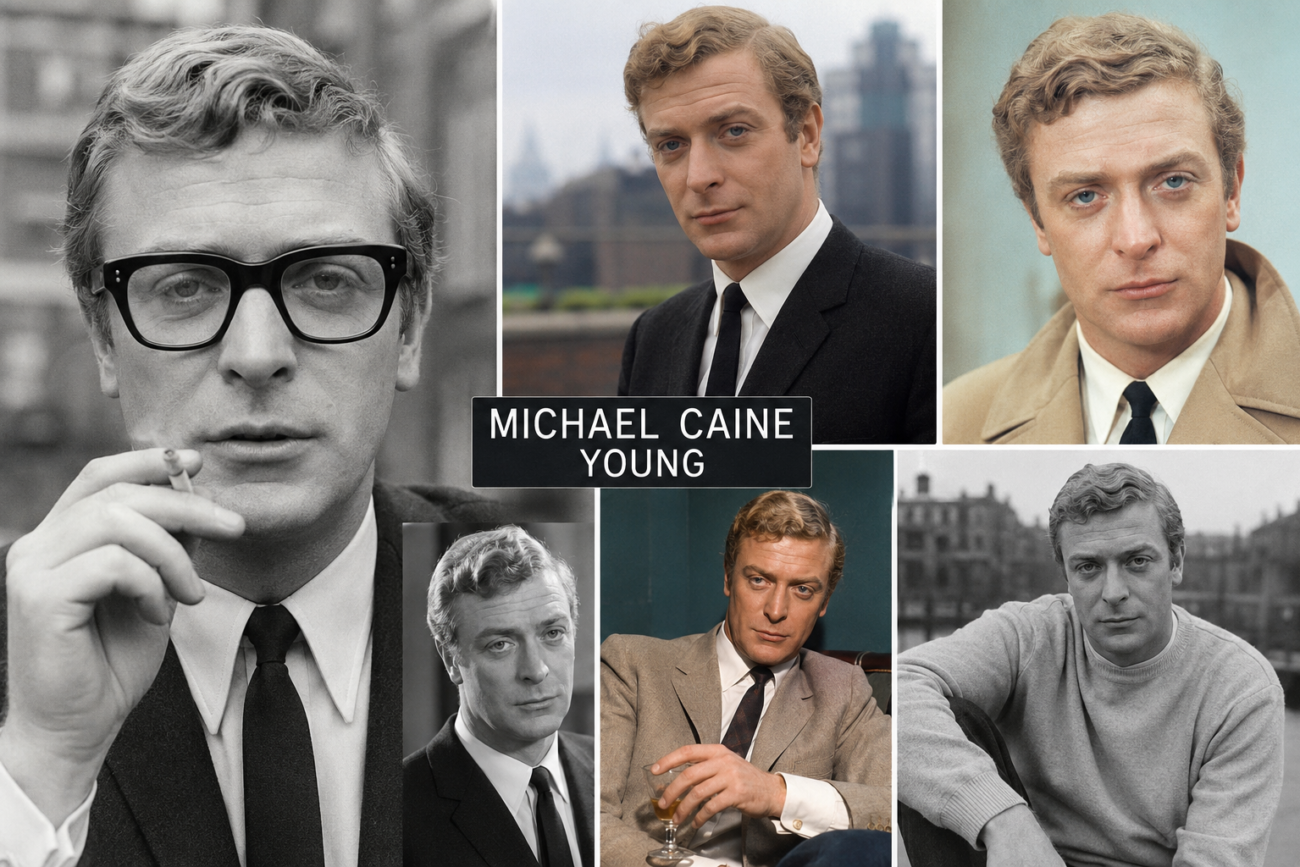
Photographs of Michael Caine young often show a sharply dressed, confident-looking man with the distinctive glasses and hairstyle that later became associated with his public image.
However, his early life was not defined by celebrity or wealth. Caine had to work his way into the entertainment industry. His early career was built through persistence rather than immediate success.
The official biography of Caine notes that he left school at 16 and initially worked as a filing clerk for Peak Films. That experience gave him an early connection to the film industry, although he was still far from becoming an actor.
His early working life included a number of ordinary jobs. This period is important because it demonstrates how different his circumstances were before he became a major star.
Michael Caine’s Education and First Interest in Film
Caine attended Hackney Downs Grocers’ School after winning a scholarship and later attended Wilson’s Grammar School. He eventually left school at around 16.
His interest in film developed early. According to his official timeline, he was taken to see his first movie at the age of four, an experience that helped begin his fascination with cinema.
Although he did not follow the traditional path associated with formal drama-school training, he gradually discovered that acting was the career he wanted to pursue.
That decision would lead him through years of uncertainty before his major breakthrough.
Military Service Before Acting Fame
One of the lesser-known aspects of Michael Caine young is his military background.
From 1951 to 1953, he completed National Service with the Queen’s Royal Regiment and the Royal Fusiliers. He served in Germany and Korea, including active duty during the Korean War.
His military experience became an important part of his life story. It also gave him experiences far removed from the film sets and premieres that would later define his public career.
After leaving the Army, Caine returned to civilian life and began working toward becoming an actor.
The Struggle to Become an Actor
Caine’s path into professional acting was difficult.
After military service, he worked at Westminster Repertory in Horsham and later at Lowestoft Repertory. These theatre jobs gave him valuable experience and helped him develop the skills needed for professional performance.
He also faced long periods when acting work was scarce. Like many performers trying to establish themselves, he accepted minor roles and ordinary jobs to survive.
His first credited film role came in A Hill in Korea in 1956. It was not a major breakthrough, but it represented an important step forward.
The years that followed were filled with small television, theatre, and film appearances. Caine later described this period as extremely difficult, and there were moments when he seriously considered abandoning acting.
How Michael Caine Got His Name
An interesting part of the Michael Caine story is that he was not originally known by that name.
He was born Maurice Joseph Micklewhite. Early in his acting career, he used the professional name Michael Scott. However, his agent discovered that another actor was already using that name.
Caine needed a new stage name. According to his official biography, while standing in a Leicester Square telephone box, he looked around and noticed that The Caine Mutiny was being shown at the Odeon cinema. He chose “Michael Caine” as his new professional name.
The name eventually became one of the most recognizable in British cinema.
Michael Caine Young and the Turning Point: Zulu
The biggest transformation in Caine’s early career came with Zulu.
In 1963, he travelled to South Africa to film the historical war movie. He played Lieutenant Gonville Bromhead, a role that brought him considerably more attention than his earlier minor performances. The official Michael Caine timeline identifies Zulu as a major turning point in his film career.
The importance of Zulu was not simply the size of the role. It demonstrated that Caine could hold the screen in a major production and helped introduce him to a much larger audience.
For someone who had spent years struggling for acting opportunities, the film represented a significant breakthrough.
From The Ipcress File to International Recognition
Following Zulu, Caine’s career moved rapidly.
He was cast as British spy Harry Palmer in The Ipcress File. The role was different from the traditional glamorous secret-agent image. Palmer was more understated, intelligent, and grounded, helping Caine establish a distinctive screen identity.
His portrayal was successful enough to lead to further Harry Palmer films.
This period also demonstrated one of Caine’s greatest strengths: his ability to make characters feel believable without relying on exaggerated performances.
Alfie Made Michael Caine a Star
If Zulu opened the door, Alfie helped make Michael Caine a major star.
Released in 1966, Alfie featured Caine as a womanizing Cockney character whose charm and self-confidence concealed a more complicated personality. The film became a defining moment in his early career.
The role earned Caine his first Academy Award nomination for Best Actor and helped establish him as one of Britain’s leading screen performers.
Importantly, Alfie showed that Caine could carry a film rather than simply contribute to an ensemble cast.
Michael Caine Young in the 1960s
The 1960s were the decade in which Caine transformed from a struggling actor into an international star.
Some of the most important films from this period included:
| Film | Year | Importance |
| A Hill in Korea | 1956 | Early film role |
| Zulu | 1964 | Major career breakthrough |
| The Ipcress File | 1965 | Introduced Harry Palmer |
| Alfie | 1966 | Established Caine as a major star |
| The Italian Job | 1969 | Became one of his best-known British films |
His career was expanding quickly, and his distinctive voice, appearance, London background, and understated acting style helped separate him from many other leading men of the era.
Why Michael Caine’s Young Years Matter to His Career
Understanding Michael Caine young provides important context for his later success.
His background was not that of a traditional Hollywood star. He came from a modest South London family, left school relatively young, completed military service, struggled for acting work, and spent years taking minor roles.
That background became part of his appeal.
Caine could convincingly portray characters from different social backgrounds because his own experiences gave him familiarity with working-class London life as well as the professional world he later entered.
His early struggles also appear to have contributed to his practical attitude toward work. Rather than arriving as an overnight sensation, he built his career gradually.
Michael Caine’s Acting Style in His Early Career
Young Michael Caine developed a style that combined restraint, confidence, humor, and natural dialogue.
He was particularly effective at playing characters who appeared relaxed on the surface while concealing complicated motives or emotions.
His performances in The Ipcress File and Alfie illustrate this quality in different ways. Harry Palmer was intelligent and understated, while Alfie was charismatic but morally complicated.
This versatility became one of the foundations of Caine’s long career.
From Young Actor to British Film Icon
Caine’s early success eventually led to a career spanning several decades. He went on to appear in acclaimed films including The Italian Job, Get Carter, Educating Rita, Hannah and Her Sisters, The Cider House Rules, and many others.
His achievements include two Academy Awards for Best Supporting Actor, one for Hannah and Her Sisters and another for The Cider House Rules. He was also recognized by BAFTA and was knighted in 2000 for his contribution to cinema.
The contrast between those later achievements and his difficult early years is what makes his story especially compelling.
Frequently Asked Questions
What was Michael Caine’s real name?
Michael Caine was born Maurice Joseph Micklewhite on March 14, 1933, in South London. He adopted the professional name Michael Caine during his early acting career.
Where did Michael Caine grow up?
He grew up in South London, particularly around Southwark and the Elephant and Castle area. His childhood was shaped by wartime Britain and postwar London.
What was Michael Caine’s first movie?
His first film role was in A Hill in Korea, released in 1956. The film featured George Baker and Stanley Baker.
What movie made Michael Caine famous?
Zulu was a major breakthrough, while The Ipcress File and Alfie established him as a leading British screen actor.
How old was Michael Caine when he became famous?
Caine was in his early 30s when his career began to change dramatically. He was around 30 when he filmed Zulu and 33 when Alfie was released.
Did Michael Caine serve in the military?
Yes. He completed National Service from 1951 to 1953 with the Queen’s Royal Regiment and the Royal Fusiliers and served in Germany and Korea.
Did Michael Caine go to drama school?
His route into acting was not based on a conventional drama-school career. He developed his experience through repertory theatre, television, and small film roles before achieving mainstream success.
What are Michael Caine’s most famous early films?
Among his best-known early films are Zulu, The Ipcress File, Alfie, and The Italian Job. These films helped establish his reputation in British and international cinema.
Conclusion
The story of Michael Caine young is ultimately a story of persistence rather than overnight success. Born Maurice Joseph Micklewhite in South London, he grew up during difficult times, completed military service, worked ordinary jobs, and spent years trying to establish himself as an actor.
His early film roles were modest, but Zulu changed the direction of his career. The Ipcress File gave him a memorable character in Harry Palmer, while Alfie transformed him into a major star.
What makes Caine’s early career especially interesting is the distance between where he started and where he eventually arrived. His South London upbringing, military experience, years of theatrical work, and persistence through professional setbacks all formed part of the foundation for his extraordinary career.
Looking at Michael Caine young therefore means looking beyond photographs. It means understanding the difficult journey that turned a young Londoner with limited opportunities into one of Britain’s most enduring film legends.
