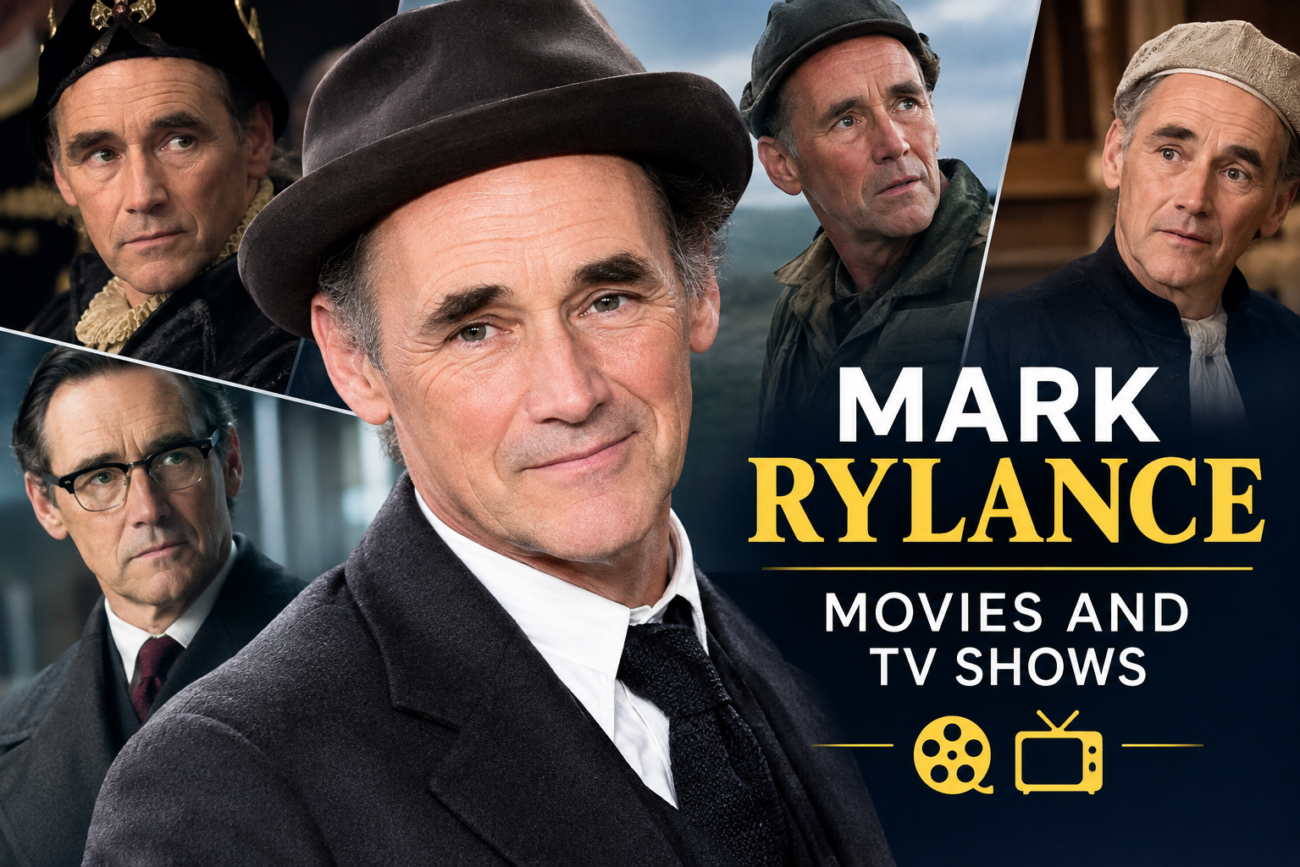
Mark Rylance is one of the most acclaimed English actors of his generation, with a career spanning theatre, television, and film. Known for his distinctive performances and deep connection to classical theatre, he has earned major recognition on both sides of the Atlantic.
Born in Ashford, Kent, in 1960, Rylance developed his reputation primarily through stage acting before becoming internationally recognized for screen roles. His career includes Shakespearean performances, award-winning Broadway work, television dramas such as Wolf Hall, and major films including Bridge of Spies, The BFG, Dunkirk, and The Trial of the Chicago 7.
This guide explores Mark Rylance’s early life, education, theatre career, filmography, television work, major awards, and lasting influence as a performer and theatre artist.
Key Takeaways
- Mark Rylance was born on January 18, 1960, in Ashford, Kent, England.
- He is an actor, playwright, and theatre director whose career began professionally in 1980.
- He served as the first artistic director of Shakespeare’s Globe in London from 1995 to 2005.
- His major film breakthrough came with Bridge of Spies, for which he won the Academy Award for Best Supporting Actor.
- Rylance has won three Tony Awards for Broadway performances and multiple Olivier Awards for his theatre work.
- His television credits include The Government Inspector and Wolf Hall.
Biography Table
| Detail | Information |
|---|---|
| Full Name | Sir David Mark Rylance Waters |
| Date of Birth | January 18, 1960 |
| Age | 66 years old as of September 2026 |
| Birthplace | Ashford, Kent, England |
| Nationality | English/British |
| Profession | Actor, playwright, theatre director |
| Education | Royal Academy of Dramatic Art (RADA) |
| Years Active | 1980–present |
| Known For | Bridge of Spies, Wolf Hall, The BFG, Dunkirk, Jerusalem, Twelfth Night |
| Major Achievements | Academy Award, BAFTA Awards, Tony Awards, Olivier Awards and other honours |
| Estimated Net Worth | Not included because reliable public figures vary significantly |
Biographical records identify Rylance’s birth name as David Mark Rylance Waters and list RADA among his educational background.
Who Is Mark Rylance?
Mark Rylance is an English actor, playwright, and theatre director particularly respected for his stage performances. While international audiences became increasingly familiar with him through film and television, theatre has remained central to his career.
He became especially associated with Shakespeare after performing numerous classical roles and later serving as the first artistic director of Shakespeare’s Globe in London. His work there helped establish his reputation as one of Britain’s leading theatre performers.
His career is notable because he has achieved major recognition in several different areas of acting. He has received prestigious awards for theatre, television, and cinema rather than becoming known exclusively for one medium.
Early Life and Education
Mark Rylance was born on January 18, 1960, in Ashford, Kent. His parents were English teachers, and his family moved to the United States when he was young. He grew up partly in Connecticut and Wisconsin, where his interest in performing developed during his school years.
As a student, Rylance participated extensively in school theatre. He performed in Shakespearean productions, including Hamlet and Romeo and Juliet, experiences that helped establish his long-standing interest in classical drama.
He later returned to England and studied at the Royal Academy of Dramatic Art. After completing his training, he began building a professional career on the British stage.
Mark Rylance’s Theatre Career
Theatre has arguably been the foundation of Mark Rylance’s career.
He made his professional stage debut at the Citizens Theatre in Glasgow in 1980. He subsequently worked with major British theatre companies and developed a reputation for taking on demanding classical and contemporary roles.
His Shakespearean work became particularly important. Early performances included roles in productions of The Tempest, A Midsummer Night’s Dream, Hamlet, and Romeo and Juliet.
Shakespeare’s Globe
One of the defining chapters of Rylance’s career came when he became the first artistic director of Shakespeare’s Globe in London.
He held the position from 1995 to 2005. During this period, he combined performance with artistic leadership and became closely associated with the Globe’s distinctive approach to presenting Shakespeare.
His involvement with the theatre was significant not only because of his acting but also because it placed him at the center of one of Britain’s most recognizable Shakespeare institutions.
Broadway Success
Rylance’s stage career eventually expanded to Broadway, where he became a particularly successful performer.
His Broadway credits include:
- Boeing-Boeing
- La Bête
- Jerusalem
- Richard III
- Twelfth Night
- Farinelli and the King
His performance in Boeing-Boeing earned him a Tony Award in 2008. He won another Tony for Jerusalem in 2011 and a third for Twelfth Night in 2014.
These performances demonstrated his versatility. He could move between comedy, classical tragedy, contemporary drama, and highly stylized theatrical roles without being confined to one type of character.
Mark Rylance’s Film Career
Although Rylance built his reputation on stage, cinema eventually introduced his work to a much wider international audience.
His screen career includes films from different genres, ranging from historical dramas and literary adaptations to major studio productions.
Bridge of Spies
One of the most important films in Mark Rylance’s career is Steven Spielberg’s Bridge of Spies.
Released in 2015, the historical drama stars Tom Hanks as attorney James B. Donovan, while Rylance plays Soviet spy Rudolf Abel.
Rylance’s understated performance attracted widespread critical acclaim. He won the Academy Award for Best Supporting Actor as well as the BAFTA Award for Best Supporting Actor.
The role was particularly important because it showed how effective Rylance’s restrained acting style could be on the big screen. Rather than relying on exaggerated emotion, he used small gestures, timing, and controlled delivery to create a memorable character.
The BFG
Rylance reunited with Spielberg for The BFG, the 2016 fantasy film based on Roald Dahl’s children’s novel.
He played the title character, the Big Friendly Giant, in a performance that required him to combine motion-capture work with voice and physical performance.
The film introduced Rylance to younger audiences while demonstrating his ability to lead a large-scale family production.
Dunkirk
In Christopher Nolan’s 2017 war film Dunkirk, Rylance played Mr. Dawson, a civilian sailor who crosses the English Channel to help rescue Allied troops.
The role was considerably different from his work in Bridge of Spies. Instead of playing a reserved historical figure, he portrayed an ordinary civilian placed in extraordinary circumstances.
The film further established Rylance as a versatile supporting performer capable of bringing emotional depth to relatively understated characters.
Ready Player One
Rylance worked with Spielberg again in Ready Player One (2018), a science-fiction adventure based on Ernest Cline’s novel.
He played James Halliday, the eccentric creator of the virtual world known as the OASIS. The role allowed Rylance to combine dramatic performance with a more unconventional, technology-driven character.
The Trial of the Chicago 7
Rylance appeared in Aaron Sorkin’s The Trial of the Chicago 7 (2020), a historical courtroom drama.
The ensemble cast received major recognition, including a Screen Actors Guild Award for Outstanding Performance by a Cast in a Motion Picture.
Other Notable Films
Some other notable Mark Rylance movies include:
| Film | Year | Role/Significance |
|---|---|---|
| Prospero’s Books | 1991 | Early major film work |
| Angels & Insects | 1995 | Period drama |
| Intimacy | 2001 | Contemporary drama |
| The Other Boleyn Girl | 2008 | Historical drama |
| Anonymous | 2011 | Historical drama |
| Bridge of Spies | 2015 | Rudolf Abel; Academy Award-winning performance |
| The BFG | 2016 | The BFG |
| Dunkirk | 2017 | Mr. Dawson |
| Ready Player One | 2018 | James Halliday |
| The Trial of the Chicago 7 | 2020 | Historical courtroom drama |
| Don’t Look Up | 2021 | Ensemble satire |
| The Phantom of the Open | 2021 | Maurice Flitcroft |
| Bones and All | 2022 | Supporting role |
| The Outfit | 2022 | Leonard |
His filmography demonstrates the breadth of his screen career, from independent and art-house productions to major Hollywood films.
Mark Rylance on Television
Rylance has also delivered acclaimed television performances.
One of his notable early television roles came in The Government Inspector, a Channel 4 drama in which he portrayed David Kelly. His performance earned him a BAFTA Television Award for Best Actor.
Another major television role was Thomas Cromwell in Wolf Hall, the BBC adaptation of Hilary Mantel’s historical novels.
Rylance’s portrayal of Cromwell earned widespread recognition and a BAFTA Television Award. He also received nominations for major international awards, including the Primetime Emmy and Golden Globe.
Mark Rylance’s Major Awards
Rylance’s award history reflects the unusual breadth of his career.
Academy Award
His most prominent film honour came in 2016, when he won the Academy Award for Best Supporting Actor for Bridge of Spies.
BAFTA Awards
Rylance has received BAFTA recognition for both film and television. His Bridge of Spies performance earned the BAFTA Film Award for Best Supporting Actor, while his work in Wolf Hall earned the BAFTA Television Award for Best Leading Actor.
Tony Awards
His Broadway career produced three Tony Award wins:
- Boeing-Boeing — 2008
- Jerusalem — 2011
- Twelfth Night — 2014
His Broadway record is one of the clearest indicators of his standing as a theatre performer.
Olivier Awards
Rylance has also won major Olivier Awards for his work on the London stage, including recognition for Much Ado About Nothing and Jerusalem.
What Makes Mark Rylance’s Acting Distinctive?
Rylance is often associated with an understated and highly controlled acting style.
Instead of relying heavily on obvious emotional signals, he can create characters through pauses, subtle changes in expression, vocal rhythm, and physical detail.
This approach works particularly well in theatre, where small choices can carry considerable meaning, but it has also translated successfully to film.
His performance as Rudolf Abel in Bridge of Spies is a strong example. The character’s restraint becomes part of the performance rather than a limitation.
His career also demonstrates unusual range. He has played Shakespearean characters, historical figures, fictional politicians, eccentric inventors, fantasy characters, and ordinary people facing extraordinary circumstances.
Mark Rylance’s Contribution to Theatre
Rylance’s importance extends beyond his acting credits.
His leadership at Shakespeare’s Globe made him an important figure in the modern presentation of Shakespeare. His stage career also helped demonstrate that serious theatre actors could move successfully between London theatre, Broadway, television, and international cinema.
His achievements are especially notable because theatre remained a central part of his professional identity even after he became widely recognized as a film actor.
Is Mark Rylance Mainly a Film or Theatre Actor?
It is difficult to place Rylance exclusively in either category.
His international fame increased significantly through films such as Bridge of Spies, but his artistic reputation was established through decades of theatre work.
A useful way to understand his career is:
| Area | Importance to His Career |
|---|---|
| Theatre | Foundation of his reputation |
| Shakespeare | Major artistic specialty |
| Broadway | Source of three Tony wins |
| Film | International recognition |
| Television | Major award-winning performances |
| Directing/Artistic Leadership | Important through Shakespeare’s Globe |
This combination is what makes his career distinctive.
Frequently Asked Questions
How old is Mark Rylance?
Mark Rylance was born on January 18, 1960. As of September 2026, he is 66 years old.
What is Mark Rylance best known for?
He is best known for his acclaimed theatre career, his work at Shakespeare’s Globe, and film and television performances including Bridge of Spies, Wolf Hall, The BFG, and Dunkirk.
Did Mark Rylance win an Oscar?
Yes. He won the Academy Award for Best Supporting Actor for playing Rudolf Abel in Bridge of Spies.
How many Tony Awards has Mark Rylance won?
Mark Rylance has won three Tony Awards. His wins came for Boeing-Boeing, Jerusalem, and Twelfth Night.
Was Mark Rylance the artistic director of Shakespeare’s Globe?
Yes. He served as the first artistic director of Shakespeare’s Globe in London from 1995 to 2005.
What was Mark Rylance’s role in Wolf Hall?
Rylance played Thomas Cromwell in the 2015 television adaptation of Hilary Mantel’s historical novels. His performance earned a BAFTA Television Award and several other award nominations.
What are some of Mark Rylance’s best-known movies?
Notable films include Bridge of Spies, The BFG, Dunkirk, Ready Player One, The Trial of the Chicago 7, Don’t Look Up, The Outfit, and Bones and All.
Is Mark Rylance a theatre director as well as an actor?
Yes. He is an actor, playwright, and theatre director, and his leadership of Shakespeare’s Globe was an important part of his career.
Conclusion
Mark Rylance has built an unusually versatile career across theatre, television, and film. His roots are firmly in the stage, where Shakespearean performances, London productions, Broadway successes, and his leadership of Shakespeare’s Globe established his reputation.
His transition to international cinema brought another level of recognition, particularly through his Oscar-winning performance as Rudolf Abel in Bridge of Spies. Television roles such as Thomas Cromwell in Wolf Hall further demonstrated his ability to bring subtle, complex characters to the screen.
What makes Mark Rylance especially notable is not simply the number of awards he has received, but the breadth of his work. From Shakespeare and Broadway to major Hollywood productions and acclaimed television dramas, his career illustrates how a theatre-centered performer can achieve lasting success across multiple forms of storytelling.
