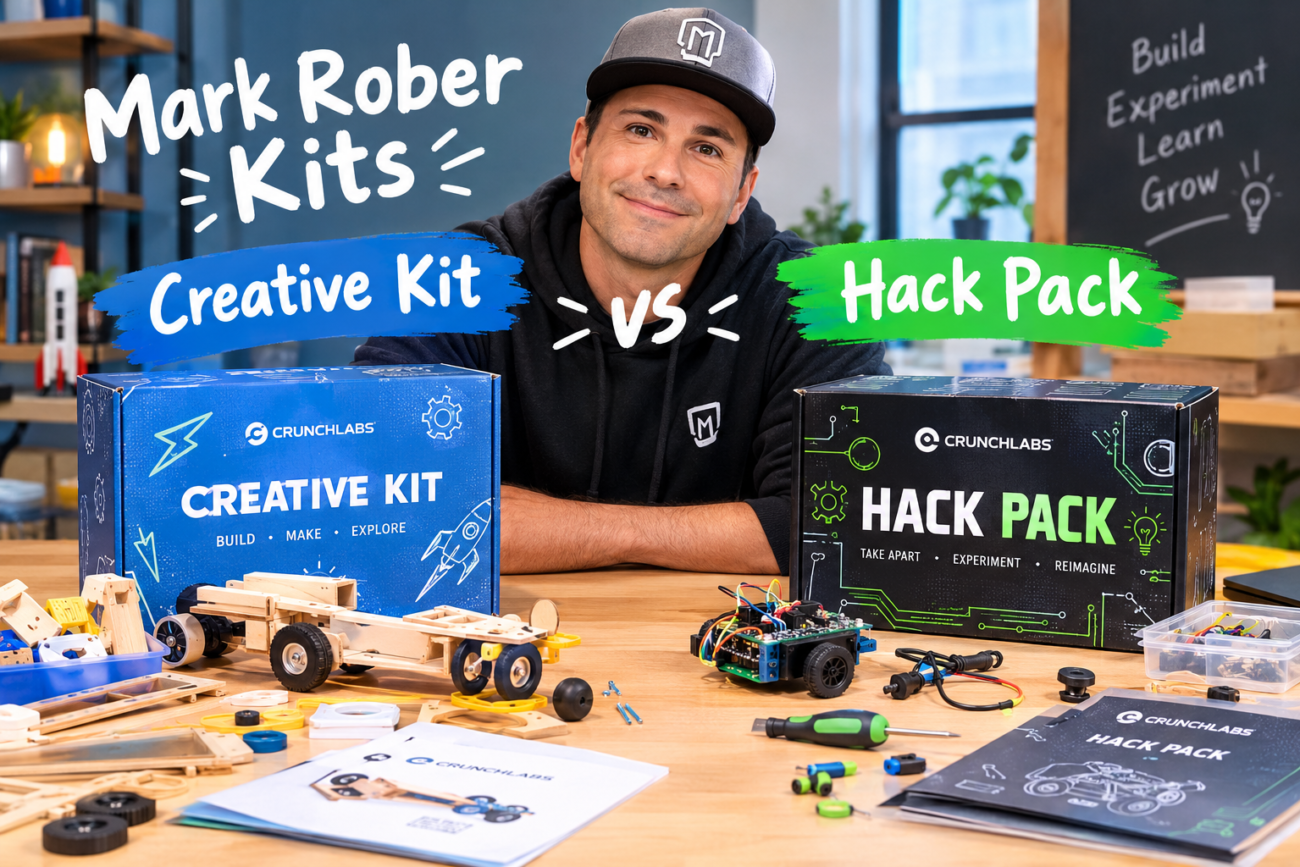
If you are researching mark rober kits, two names you are likely to encounter are the Creative Kit and Hack Pack. Both are designed around hands-on STEM activities, but they can appeal to different interests and learning styles.
Mark Rober, a former NASA engineer and popular science communicator, has built a large audience around making engineering and science approachable through practical projects. His educational subscription kits extend that philosophy beyond videos by giving learners physical materials and projects to build.
But which kit is the better fit? The answer depends on what you want from a STEM activity: structured building, creative experimentation, engineering challenges, or opportunities to explore how everyday technology works.
This guide explains the differences between the Creative Kit and Hack Pack, what to consider before choosing one, and how these types of projects can support hands-on STEM learning.
Key Takeaways
- Mark Rober kits are designed to make STEM concepts more engaging through hands-on projects.
- The Creative Kit and Hack Pack approach learning from somewhat different angles.
- Creative Kit activities generally emphasize building, making, and experimenting.
- Hack Pack activities are geared toward exploring technology, engineering concepts, and creative problem-solving.
- The right choice depends on the learner’s age, interests, experience, and preferred type of project.
- Parents should consider supervision, project complexity, available space, and the learner’s enthusiasm before subscribing.
Main Article
What Are Mark Rober Kits?
The term Mark Rober kits commonly refers to hands-on STEM products associated with Mark Rober’s educational brand, particularly the subscription kits developed through CrunchLabs.
The basic idea is straightforward: instead of only watching an explanation of a scientific or engineering concept, the learner gets materials that can be used to build something.
This approach can make abstract ideas easier to understand because learners can see a mechanism operate and modify or test what they have built.
Typical STEM kit activities can involve concepts such as:
- Mechanical engineering
- Physics
- Design
- Problem-solving
- Building and prototyping
- Simple machines and mechanisms
- Creative experimentation
- Engineering-based thinking
The appeal is not simply the finished project. The process of assembling, testing, troubleshooting, and improving something can be an important part of the learning experience.
Creative Kit vs. Hack Pack: What’s the Difference?
The most useful way to distinguish these options is to consider the kind of experience each one is intended to provide.
| Feature | Creative Kit | Hack Pack |
|---|---|---|
| Primary focus | Building and creative STEM activities | Technology, experimentation, and engineering concepts |
| Learning style | Guided, hands-on projects | Exploration and problem-solving |
| Best for | Learners who enjoy making things | Learners interested in how things work |
| Typical appeal | Creating a tangible project | Experimenting and discovering |
| Skill development | Building, design, mechanics | Engineering thinking and technical exploration |
| Ideal experience | Structured project-based learning | More exploratory STEM engagement |
Exact projects, included materials, subscription options, and product names can change over time, so readers should check the current product information before ordering.
The distinction is therefore best viewed as a difference in learning experience, rather than assuming that one kit is universally better than the other.
What Makes the Creative Kit Different?
The Creative Kit concept centers on making and building.
For someone who enjoys taking individual components and turning them into a functioning object, this type of STEM kit can be particularly appealing.
A project-based format can also make learning feel less like traditional coursework. Instead of starting with a long theoretical explanation, learners can begin with a practical challenge and discover the underlying concepts while working through it.
Who Might Enjoy a Creative Kit?
A Creative Kit may appeal to learners who:
- Enjoy hands-on activities
- Like building physical objects
- Prefer learning by doing
- Enjoy following project instructions
- Are interested in engineering and design
- Like seeing an immediate result from their work
It can also work well for families looking for an activity that gives children something concrete to work on away from screens.
What Is the Hack Pack?
The Hack Pack takes a somewhat different approach to STEM learning by emphasizing experimentation, technology, and understanding how things work.
The word “hack” in this context does not necessarily mean anything related to illegal computer activity. Rather, it can refer to creatively modifying, experimenting with, or finding new ways to use technology and everyday concepts.
That makes the concept particularly interesting for learners who naturally ask questions such as:
- Why does this work?
- What happens if I change this?
- Can I make it work differently?
- How could I improve this design?
- What engineering principle is behind this?
This type of curiosity is closely connected to the iterative process used in engineering: build, test, identify a problem, modify the design, and test again.
Mark Rober Kits and STEM Learning
One of the strongest educational ideas behind hands-on STEM kits is that they turn passive learning into an active process.
Reading about physics can teach a concept. Building something that demonstrates the concept can provide another layer of understanding.
For example, when a learner builds a mechanism, they may encounter concepts involving:
- Force
- Motion
- Balance
- Friction
- Energy
- Leverage
- Mechanical advantage
- Structural design
The educational value comes partly from connecting the physical result with the underlying idea.
Learning Through Trial and Error
Engineering rarely works perfectly on the first attempt.
A component may not fit correctly. A mechanism may fail to move as expected. A design may need adjustment.
Those moments can become useful learning opportunities.
Instead of treating failure as simply a mistake, project-based STEM activities can encourage learners to ask what went wrong and what could be changed.
That is an important distinction between simply assembling a toy and engaging with an engineering challenge.
Which Mark Rober Kit Is Right for You?
There is no single answer because the ideal choice depends on the learner.
Choose Based on Interest
Consider what the learner naturally enjoys.
A Creative Kit may be a better fit if they:
- Like construction projects
- Enjoy creating physical objects
- Prefer structured activities
- Like seeing a finished product
- Are interested in design and mechanics
A Hack Pack may be more appealing if they:
- Like experimenting
- Ask how technology works
- Enjoy modifying things
- Prefer discovery-based activities
- Are curious about engineering concepts
The distinction is less about ability and more about interest.
A child who loves taking things apart may respond differently to a kit than one who enjoys carefully following construction instructions.
Are Mark Rober Kits Good for Kids?
Hands-on STEM kits can be useful educational activities for children, but suitability depends on the individual project and the child’s age and abilities.
Parents should consider the manufacturer’s recommended age range and project requirements before purchasing.
It is also worth considering whether the child can complete the activity independently or whether an adult will need to help.
Some projects may involve small components, tools, detailed assembly, or steps that require patience and careful attention.
The Role of Parents
Parents do not necessarily need to teach the entire project.
In many cases, a better role is to encourage questions and let the learner work through problems independently when appropriate.
Instead of immediately fixing a problem, try asking:
What do you think is causing it?
Or:
What could you change and test?
That turns the activity into a problem-solving exercise rather than simply an assembly task.
What Skills Can Mark Rober Kits Help Develop?
The educational benefits of a hands-on project depend on the specific activity, but STEM kits can provide opportunities to practice several useful skills.
Problem-Solving
When something does not work, learners need to identify possible causes and determine what to try next.
Following Instructions
Detailed projects require learners to interpret diagrams, sequence steps, and pay attention to details.
Spatial Reasoning
Building physical objects can help learners think about how components fit together and how movement occurs in three-dimensional space.
Creativity
Once learners understand the basic construction, experimentation can encourage them to think about alternative designs or uses.
Persistence
Projects that require troubleshooting can teach learners that an unsuccessful first attempt does not necessarily mean the project has failed.
Engineering Thinking
Perhaps most importantly, hands-on projects can introduce the iterative mindset used in engineering: design, build, test, evaluate, and improve.
What Should Parents Consider Before Buying?
A STEM subscription can be a good fit for one family and a poor fit for another. Before purchasing Mark Rober kits, consider several practical factors.
1. Age and Skill Level
Check the current recommended age range and project requirements.
A kit that is too simple may become boring, while one that is too complicated can become frustrating.
2. Interest
Interest matters more than forcing a STEM activity on someone who has no enthusiasm for it.
If the learner enjoys building, mechanics, technology, or experimentation, they are more likely to engage with the project.
3. Adult Assistance
Determine whether the learner can reasonably complete the activities independently or whether an adult should be available.
4. Space
Some projects are easier to complete on a dedicated table or workspace than on a small desk.
5. Subscription Cost
Because subscription products can involve recurring payments, review the current pricing, shipping terms, renewal conditions, and cancellation policy before subscribing.
6. Project Frequency
Think about whether the learner will actually use each kit.
A subscription makes more sense when the recipient regularly looks forward to hands-on projects rather than allowing boxes to accumulate unopened.
Mark Rober Kits vs. Traditional STEM Toys
Traditional STEM toys and subscription kits can both support hands-on learning, but the experience can be different.
| Factor | Subscription STEM Kit | Traditional STEM Toy |
|---|---|---|
| New projects | Delivered periodically | Usually purchased individually |
| Project structure | Often guided | Varies widely |
| Variety | Changes over time | Depends on the product |
| Learning experience | Project-based | Can be open-ended or structured |
| Commitment | May involve recurring payments | Usually one-time purchase |
| Best suited to | Regular project-based learning | Specific interests or activities |
Neither format is automatically better.
The important question is whether the product matches the learner’s interests and whether they will actually use it.
How to Get More Educational Value From a STEM Kit
Simply completing a project can be fun, but families can extend the learning experience by asking questions after the build.
For example:
- What scientific principle makes it work?
- Which part was the most difficult?
- What would happen if one component were changed?
- Could the design be made faster, stronger, or more efficient?
- What would you redesign?
- Can you explain how it works to someone else?
These questions encourage learners to move beyond assembly and toward understanding.
Turn the Project Into an Experiment
After completing a project, change one variable.
For example, if a mechanism involves movement, ask what happens when a particular component is repositioned or modified.
The goal is not necessarily to improve the original design. The goal is to encourage curiosity and experimentation.
Are Mark Rober Kits Worth It?
Whether a Mark Rober kit is worthwhile depends on what you expect to get from it.
For someone who enjoys hands-on STEM activities, the value may come from having a structured project delivered regularly and from the motivation associated with building something tangible.
For someone who rarely enjoys construction projects, even an engaging STEM kit may spend more time sitting unused than being built.
A sensible way to evaluate the purchase is to consider:
- How often the learner enjoys STEM projects
- Whether they prefer building or experimenting
- Whether the current projects match their interests
- How much adult assistance is available
- The total recurring cost
- Whether the learner is excited about receiving and completing the kits
The right question is not simply whether the product is “worth it.” It is whether the experience provides enough value for the particular learner and family.
Frequently Asked Questions
What are Mark Rober kits?
Mark Rober kits are hands-on STEM learning products associated with Mark Rober and CrunchLabs. They provide projects intended to encourage building, experimentation, engineering, and problem-solving.
What is the difference between Creative Kit and Hack Pack?
The Creative Kit generally emphasizes hands-on building and creative STEM projects, while Hack Pack is oriented more toward experimentation, technology, and understanding or modifying how things work. Specific offerings can change over time.
Are Mark Rober kits suitable for children?
They can be, depending on the individual project and the child’s age and abilities. Parents should always check the current recommended age range and project requirements before purchasing.
Do parents need to help with Mark Rober kits?
The amount of assistance varies by project and by the child’s experience. Younger children or beginners may benefit from adult supervision or help with challenging steps.
Do Mark Rober kits teach STEM?
The projects are designed around STEM-related concepts and hands-on learning. The exact concepts covered depend on the individual kit and project.
Are Mark Rober kits subscription products?
Some CrunchLabs offerings use subscription models. Because product plans, pricing, and terms can change, prospective customers should review the current subscription details before ordering.
Can adults enjoy Mark Rober kits?
Yes. Adults who enjoy engineering, building, science, or hands-on projects may also find this type of activity entertaining. The appropriate choice depends on the individual’s interests and the specific kit.
Should I choose Creative Kit or Hack Pack?
Consider the learner’s interests first. Someone who enjoys structured building may prefer the Creative Kit experience, while someone who enjoys experimentation and exploring how technology works may be more interested in Hack Pack.
Conclusion
Mark Rober kits combine entertainment with hands-on STEM activities, giving learners an opportunity to build, experiment, troubleshoot, and explore engineering concepts.
The Creative Kit and Hack Pack can appeal to different types of learners. Creative Kit activities may be particularly attractive to people who enjoy building tangible projects, while Hack Pack can suit those who are curious about experimentation and how technology works.
Before choosing, consider the learner’s age, interests, experience, available supervision, workspace, and the current subscription terms. Most importantly, choose a project style that encourages genuine curiosity.
A STEM kit has the greatest potential value when the learner is excited to open the box, build the project, ask questions, and discover what happens when they try something new.
