Introduction
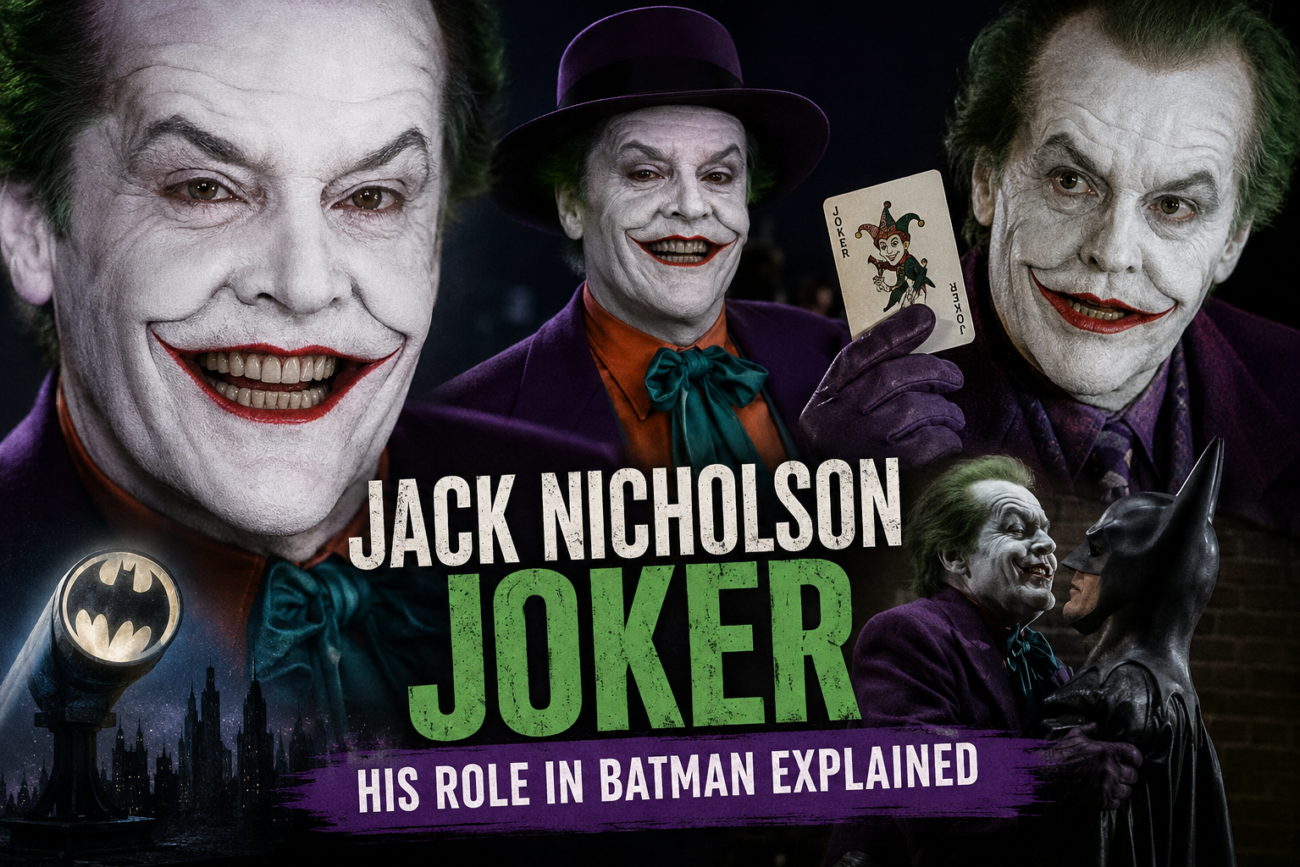
The Jack Nicholson Joker remains one of the most memorable comic-book movie performances ever put on screen. When Tim Burton’s Batman arrived in 1989, Nicholson brought a distinctive combination of menace, dark humor, theatricality, and unpredictability to the role of the Joker.
Nicholson played Jack Napier, a Gotham City gangster whose transformation into the Joker becomes one of the central events of the film. Opposite Michael Keaton’s Batman, Nicholson created a version of the villain that was very different from the grounded interpretations audiences would see in later decades.
The performance also helped establish Batman as a major Hollywood event. The film was released on June 23, 1989, and ultimately earned more than $411 million worldwide according to Box Office Mojo.
This guide explains who Nicholson’s Joker is, how the character fits into the story, what made the performance distinctive, and why it continues to be remembered decades later.
Key Takeaways
- Jack Nicholson played the Joker in Tim Burton’s 1989 film Batman.
- His character begins the movie as Gotham gangster Jack Napier.
- Napier becomes the Joker after falling into a vat of chemicals during a confrontation with Batman.
- Nicholson combined dark comedy, theatricality, violence, and improvisational energy in his portrayal.
- The role became one of the defining performances of Nicholson’s career.
- Batman became a major commercial success, earning more than $411 million worldwide in its original and reported releases.
Jack Nicholson Joker Biography Table
| Detail | Information |
|---|---|
| Full Name | John Joseph Nicholson |
| Date of Birth | April 22, 1937 |
| Age | 89 as of 2026 |
| Birthplace | Neptune City, New Jersey, United States |
| Nationality | American |
| Profession | Actor, filmmaker |
| Education | Manasquan High School |
| Years Active | 1955–2010 |
| Known For | Easy Rider, The Shining, Chinatown, One Flew Over the Cuckoo’s Nest, Batman, A Few Good Men, As Good as It Gets |
| Major Achievements | Three Academy Awards, six Golden Globe Awards, three BAFTA Awards and a Grammy Award |
| Estimated Net Worth | Widely reported estimates vary; figures are not independently verified |
Nicholson was born in 1937 and built a career spanning more than five decades. He received 12 Academy Award acting nominations and won three Oscars, making him one of the most decorated male actors in Academy history.
Jack Nicholson’s Role as the Joker in Batman
Who Does Jack Nicholson Play in Batman?
In Tim Burton’s Batman, Jack Nicholson plays Jack Napier, a gangster who becomes the Joker.
At the beginning of the story, Napier is not yet the clown-faced criminal audiences associate with the character. He is a powerful gangster involved with Gotham’s criminal underworld.
His transformation occurs during a confrontation at a chemical facility. Batman intervenes, and Napier falls into a vat of chemicals. He survives but emerges physically altered and psychologically transformed.
From that point, he adopts the identity of the Joker.
This origin story is an important difference between Burton’s film and many other versions of Batman. The Joker is presented not simply as an unexplained criminal mastermind but as a character with a specific identity and transformation.
Jack Napier Before Becoming the Joker
Jack Napier is portrayed as intelligent, confident, sarcastic, and dangerous even before his transformation.
He already possesses several qualities that later become central to the Joker:
- A taste for theatrical behavior
- A willingness to use violence
- A strong ego
- A dark sense of humor
- An interest in controlling others
- A desire for power
The chemical accident does not completely create these characteristics. Instead, it amplifies them and allows Nicholson’s performance to move into a much more exaggerated register.
How Jack Napier Becomes the Joker
One of the most important moments in Batman is Napier’s confrontation with Batman at the chemical plant.
During the encounter, Batman and Napier struggle near industrial machinery and chemicals. Napier ultimately falls into a chemical vat and is presumed dead.
He survives the incident but is severely affected by the chemicals.
His physical appearance changes dramatically. His skin becomes pale, his hair turns green, and his face develops the exaggerated smile associated with the Joker.
The character then embraces his new identity.
Rather than treating his transformation entirely as a tragedy, the film allows Nicholson’s Joker to turn it into a bizarre form of rebirth. Jack Napier effectively disappears, while the Joker becomes his new public persona.
What Makes the Jack Nicholson Joker Different?
The Joker has been portrayed by many actors, but Nicholson’s interpretation has a distinctive personality.
1. He Is Highly Theatrical
Nicholson does not play the Joker as a quiet or restrained villain.
His version enjoys being watched.
He performs for his victims, his criminal associates, Gotham’s citizens, and even Batman. His gestures, facial expressions, laughter, and delivery make almost every appearance feel like a stage performance.
This theatrical quality fits Tim Burton’s visually stylized version of Gotham.
2. He Mixes Comedy With Threat
One of the defining characteristics of Nicholson’s Joker is the way humor and violence exist side by side.
He can deliver a joke one moment and become genuinely threatening the next.
That unpredictability creates tension because viewers cannot be certain whether a particular scene will become funny, disturbing, or both.
The approach also reflects Nicholson’s broader acting style, which often combines charisma with an underlying sense of danger.
3. He Is Charismatic
Nicholson’s Joker is not portrayed as an isolated figure hiding in the shadows.
He attracts followers and commands attention.
His charisma helps explain why people around him continue to participate in his schemes despite his obvious instability.
The character’s ability to entertain is part of his power.
4. He Embraces Excess
Burton’s Batman is not aiming for the grounded realism associated with some later superhero films.
Its Gotham is stylized, gothic, colorful, and exaggerated.
Nicholson’s performance matches that world.
His Joker wears striking costumes, uses flamboyant gestures, and behaves as though Gotham itself is his personal stage.
Jack Nicholson Joker and Michael Keaton’s Batman
The effectiveness of the film depends heavily on the contrast between Nicholson’s Joker and Michael Keaton’s Batman.
Batman is generally controlled, mysterious, and physically imposing.
The Joker is expressive, loud, theatrical, and unpredictable.
This creates a useful dramatic opposition:
| Batman | Joker |
|---|---|
| Controlled | Unpredictable |
| Quiet | Talkative |
| Serious | Comic |
| Secretive | Attention-seeking |
| Order-oriented | Chaotic |
| Physically disciplined | Emotionally volatile |
The contrast makes their encounters memorable.
Rather than simply presenting two physically powerful characters, the film establishes two opposing personalities.
Batman represents Bruce Wayne’s attempt to impose justice on Gotham, while the Joker embraces disorder and spectacle.
The Joker’s Relationship With Batman
The relationship between Batman and the Joker is central to the movie.
Their conflict becomes personal because the story connects their identities before the Joker’s transformation.
This is another significant feature of the 1989 film.
The movie establishes that Napier was involved in the events surrounding Bruce Wayne’s parents’ murder, making the conflict between Batman and Joker more directly connected to Bruce Wayne’s personal history.
That interpretation differs from many other Batman stories, where the Joker’s relationship with Batman is more mysterious or developed later.
The film therefore gives their rivalry an unusually personal foundation.
Why Jack Nicholson Was Chosen
Nicholson was already a major Hollywood star when Batman was being developed.
According to the American Film Institute’s catalog, Robin Williams had initially been considered for the Joker, but Nicholson was ultimately cast. AFI also reports contemporary industry accounts concerning Nicholson’s compensation and the production’s efforts to shape the role around his personality and voice.
Nicholson’s reputation made him a particularly significant choice.
He had already demonstrated that he could play:
- Charismatic characters
- Rebellious personalities
- Morally complicated figures
- Darkly comic characters
- Intense dramatic roles
That combination made him a natural fit for Burton’s larger-than-life Joker.
Nicholson’s Joker Performance Style
Facial Expressions
Nicholson uses his face extensively to communicate the Joker’s personality.
His exaggerated smile, raised eyebrows, sudden changes in expression, and wide-eyed reactions make the character visually distinctive.
The performance does not depend entirely on dialogue.
Even when Nicholson is silent, his expressions often communicate that something unpredictable may happen.
Voice and Delivery
Nicholson’s voice is another major component of the character.
Rather than using a consistently deep or frightening voice, he shifts his delivery depending on the situation.
He can sound playful, sarcastic, excited, threatening, or almost conversational.
That variation contributes to the Joker’s unpredictability.
Physical Performance
Nicholson also uses his entire body to portray the character.
His movements can be relaxed and almost casual before suddenly becoming exaggerated.
This physical contrast helps establish the Joker as someone who does not behave according to normal social expectations.
Memorable Elements of Nicholson’s Joker
Several elements have become strongly associated with the 1989 portrayal.
The Purple Suit
The Joker’s purple clothing immediately establishes his identity.
The costume reflects the exaggerated visual style of the film and separates him from the ordinary criminals surrounding him.
The White Face and Green Hair
The makeup design creates the classic comic-book silhouette while adapting it for Burton’s darker cinematic world.
AFI records that Nicholson’s Joker makeup reportedly required around two hours to apply and about an hour to remove.
The Joker’s Laugh
Nicholson’s distinctive laugh is one of the character’s most recognizable traits.
Rather than using the laugh only as a sign of insanity, the performance often uses it almost like another form of dialogue.
The Public Persona
Nicholson’s Joker enjoys attention.
He does not simply want to defeat Batman privately. He wants to influence Gotham and turn his criminal activities into public spectacles.
That makes his villainy particularly theatrical.
How Successful Was Batman?
Batman was a major commercial success.
Box Office Mojo lists worldwide earnings of approximately $411.6 million, with more than $251 million from North America and about $160 million internationally.
The film opened in the United States on June 23, 1989, and had a reported production budget of approximately $35 million in Box Office Mojo’s current data.
The Numbers similarly records domestic earnings of about $251.2 million and worldwide earnings above $411 million.
Nicholson’s presence was a major part of the film’s appeal, and the Joker quickly became one of its most discussed elements.
Did Jack Nicholson Win an Oscar for the Joker?
No.
Nicholson did not receive an Academy Award for playing the Joker in Batman.
However, he was already an established Oscar-winning actor before taking the role.
His three Academy Awards came for:
- One Flew Over the Cuckoo’s Nest — Best Actor
- Terms of Endearment — Best Supporting Actor
- As Good as It Gets — Best Actor
He received additional nominations for several other performances.
The Joker therefore represents an interesting part of Nicholson’s career: a major commercial blockbuster role that became culturally iconic without being an awards-season performance.
Jack Nicholson’s Joker Legacy
The legacy of the Jack Nicholson Joker is closely connected to the development of modern superhero cinema.
Before the 1989 film, Batman had already been successful in comics, television, animation, and earlier films. Burton’s movie demonstrated how a comic-book property could become a major mainstream cinematic event.
Nicholson’s Joker helped make the villain a central attraction.
His interpretation also established several qualities that audiences would continue to associate with the character:
- Dark humor
- Unpredictability
- Theatricality
- Visual flamboyance
- Psychological instability
- A complicated relationship with Batman
Later actors took the character in different directions rather than simply copying Nicholson.
That distinction is important. Heath Ledger’s Joker in The Dark Knight, for example, is much more restrained, anarchic, and psychologically unsettling. Joaquin Phoenix’s Arthur Fleck in Joker is different again, focusing on social alienation and psychological deterioration.
Nicholson’s version occupies its own space in that history.
Jack Nicholson Joker vs. Other Major Joker Performances
| Actor | Film | General Interpretation |
|---|---|---|
| Jack Nicholson | Batman (1989) | Theatrical, flamboyant, darkly comic |
| Heath Ledger | The Dark Knight (2008) | Anarchic, unpredictable, psychologically intense |
| Joaquin Phoenix | Joker (2019) | Psychological, tragic, character-driven |
| Mark Hamill | Various animated projects | Highly expressive, comic-book-oriented voice performance |
These interpretations should not necessarily be ranked against one another.
Each was created for a different story and filmmaking style.
Nicholson’s Joker belongs particularly well to Burton’s gothic, stylized Gotham.
Why the Jack Nicholson Joker Still Matters
More than three decades after Batman was released, Nicholson’s performance remains recognizable because it combines several qualities that are difficult to balance.
He is funny without becoming harmless.
He is threatening without being completely humorless.
He is charismatic without becoming sympathetic.
And he is exaggerated without feeling completely disconnected from the story.
That balance is one reason the performance continues to attract attention.
The role also represents an important moment in Nicholson’s career. He had already established himself as one of Hollywood’s most respected actors, yet he was willing to embrace an unusually commercial and highly stylized comic-book role.
The result became one of his signature performances.
Frequently Asked Questions
Who played the Joker in Batman in 1989?
Jack Nicholson played the Joker in Tim Burton’s 1989 film Batman. He portrayed the character of Jack Napier, a Gotham gangster who transforms into the Joker.
What was Jack Nicholson’s Joker name?
Before becoming the Joker, Nicholson’s character is called Jack Napier. The film uses this identity as the character’s original name.
Was Jack Nicholson the first live-action Joker?
No. Other actors had portrayed versions of the Joker before Nicholson, including Cesar Romero in the 1960s Batman television series and film. Nicholson’s portrayal was particularly significant because it appeared in one of the first major modern Batman blockbusters.
Did Jack Nicholson win an Oscar for playing the Joker?
No. Nicholson did not win an Oscar for Batman. His three Academy Awards came for One Flew Over the Cuckoo’s Nest, Terms of Endearment, and As Good as It Gets.
How much did Jack Nicholson get paid for the Joker?
Contemporary reports cited by the American Film Institute gave different figures, including $5 million and $6 million for his initial compensation. AFI also notes that Nicholson’s agreement included significant financial participation in the film.
Is Jack Nicholson’s Joker in The Dark Knight?
No. Nicholson’s Joker appears in Tim Burton’s Batman from 1989. Heath Ledger played the Joker in Christopher Nolan’s The Dark Knight in 2008.
Why is Jack Nicholson’s Joker so famous?
His performance combined Nicholson’s established charisma with the Joker’s dark humor, theatrical personality, colorful appearance, and unpredictability. The success of Batman also exposed the performance to a huge international audience.
Did Jack Nicholson return as the Joker?
No. Nicholson did not reprise the Joker in a subsequent Batman movie. His performance remains associated primarily with Tim Burton’s 1989 Batman.
Conclusion
The Jack Nicholson Joker remains an important milestone in the history of Batman on film. As Jack Napier, Nicholson begins as a dangerous Gotham gangster before transforming into the flamboyant criminal known as the Joker.
What makes the performance memorable is not simply the makeup, costume, or laugh. Nicholson creates a character who is theatrical, charismatic, darkly funny, violent, and unpredictable. Those qualities fit perfectly with Tim Burton’s stylized vision of Gotham.
The success of Batman helped cement the Joker as one of cinema’s most recognizable comic-book villains, while Nicholson’s interpretation established a distinctive version that later portrayals could differ from rather than simply imitate.
For fans exploring the history of the character, Nicholson’s Joker remains essential viewing—not because it is the only way to portray the villain, but because it helped define what a major cinematic Joker could be.
