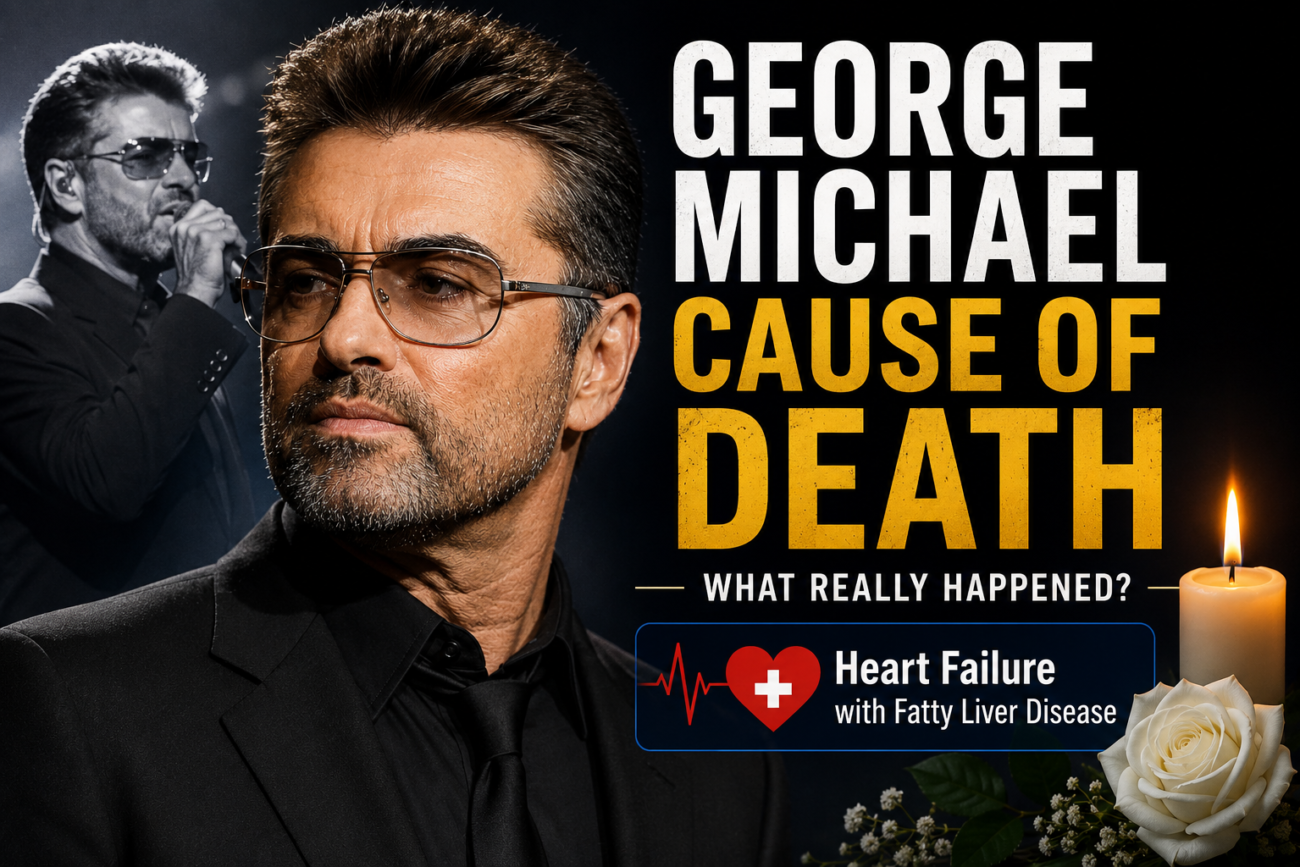
George Michael was one of the most successful British singers of his generation, first rising to international fame with Wham! before building an acclaimed solo career. His sudden death on Christmas Day 2016 shocked fans around the world and led to widespread questions about what had happened.
The George Michael cause of death was ultimately confirmed by the Oxfordshire coroner as natural causes. His final postmortem identified dilated cardiomyopathy with myocarditis and fatty liver disease.
Because early reports were incomplete and the initial postmortem did not immediately establish a cause, confusion surrounding his death persisted for several months. This article explains what was officially determined, what the medical terms mean, and how the findings differed from the speculation that circulated immediately after his death.
Key Takeaways
- George Michael died on December 25, 2016, at the age of 53.
- The official cause of death was dilated cardiomyopathy with myocarditis and fatty liver.
- The Oxfordshire coroner classified his death as natural.
- An initial postmortem was inconclusive, so additional tests were conducted.
- His earlier severe bout of pneumonia in 2011 was a separate medical event and was not listed as his cause of death.
- No suspicious circumstances were ultimately associated with his death.
Biography Table
| Detail | Information |
|---|---|
| Full Name | Georgios Kyriacos Panayiotou |
| Date of Birth | June 25, 1963 |
| Age | 53 at the time of death |
| Birthplace | East Finchley, London, England |
| Nationality | British |
| Profession | Singer, songwriter, record producer |
| Education | Bushey Meads School |
| Years Active | 1981–2016 |
| Known For | Wham!, solo music career, Faith, “Careless Whisper,” “Freedom! ’90” |
| Major Achievements | Multiple UK No. 1 singles and albums; more than 100 million records sold with Wham! and as a solo artist |
| Estimated Net Worth | Public estimates vary; no definitive figure should be treated as official |
George Michael Cause of Death: What Was Confirmed?
The official George Michael cause of death was natural causes resulting from dilated cardiomyopathy with myocarditis and fatty liver.
The finding was announced in March 2017 by Darren Salter, the senior coroner for Oxfordshire. The coroner said the final postmortem report had established a natural cause and that there was therefore no need for an inquest or further investigation.
This conclusion is important because the circumstances were initially unclear. Michael was found dead at his home in Goring, Oxfordshire, on Christmas Day 2016. At first, police described the death as unexplained but not suspicious while further medical tests were carried out.
The eventual medical findings provided a clear explanation.
What Is Dilated Cardiomyopathy?
Dilated cardiomyopathy is a condition in which the heart muscle becomes enlarged and weakened. As a result, the heart can have difficulty pumping blood efficiently around the body.
It can have several possible causes, including inherited factors, infections, high blood pressure, problems involving heart valves, and other medical or toxic influences.
In Michael’s case, the condition was identified as part of the official cause of death. The coroner’s statement did not suggest that one particular lifestyle factor should be regarded as the sole explanation for the condition.
What Is Myocarditis?
Myocarditis means inflammation of the heart muscle.
It can occur for a variety of reasons, including certain infections and immune-related processes. When the heart muscle becomes inflamed, its ability to function normally can be affected.
The combination of dilated cardiomyopathy and myocarditis was therefore significant in understanding Michael’s death. These were not merely incidental findings; they formed part of the official medical explanation provided by the coroner.
What Did Fatty Liver Mean?
The final postmortem also identified fatty liver.
Fatty liver refers to an accumulation of fat in the liver. There are different forms and possible causes, so the presence of fatty liver alone does not establish exactly why it developed in an individual.
The coroner included fatty liver alongside dilated cardiomyopathy and myocarditis in the confirmed cause of death.
Why Was the Initial Cause of Death Unclear?
When news of Michael’s death first emerged, the medical cause had not yet been established.
A postmortem examination conducted shortly after his death was described by police as inconclusive. Authorities said additional tests would be required and that the results could take several weeks. At that stage, the death was being treated as unexplained but not suspicious.
This explains why early media reports sometimes used phrases such as “heart failure” without that being the final official wording.
Michael’s manager, Michael Lippman, initially said he believed the singer had died from heart failure in bed. However, that early description was not the same as the later formal determination made by the coroner.
The final medical conclusion was more specific: dilated cardiomyopathy with myocarditis and fatty liver.
When and Where Did George Michael Die?
George Michael died on December 25, 2016, at his home in Goring, Oxfordshire, England. He was 53 years old.
His death occurred during the Christmas period, making the news particularly shocking for fans. His publicist said that he had died peacefully at home, while authorities initially investigated the circumstances as unexplained but did not consider them suspicious.
The location and date became widely reported because Michael had remained a major public figure decades after his breakthrough with Wham!.
Did George Michael Have Previous Health Problems?
Yes. Michael had experienced significant health problems before his death, most notably a severe case of pneumonia in 2011.
During his Symphonica tour that year, he became seriously ill and was treated in an intensive-care setting at a hospital in Vienna. He later explained publicly that the illness had been extremely serious and that doctors had worked to keep him alive.
Doctors described the 2011 illness as a severe pneumococcal infection that had developed into pneumonia. Michael required a tracheotomy and spent time in intensive care before recovering.
However, it is important not to confuse this episode with the official cause of his death five years later.
Was Pneumonia the Cause of His Death?
No.
Michael’s severe pneumonia in 2011 was a major earlier health crisis, but it was not identified as the cause of his death in 2016.
The final postmortem instead identified dilated cardiomyopathy, myocarditis, and fatty liver.
This distinction matters because descriptions of his previous illness sometimes appear in discussions about his death, potentially creating the impression that pneumonia was responsible.
Was George Michael’s Death Suspicious?
The official findings did not indicate that Michael died as a result of foul play.
Immediately after his death, police said there were no suspicious circumstances, although the medical cause was initially unexplained. Once the final postmortem confirmed a natural cause, the coroner discontinued the investigation and stated that there was no need for an inquest or further inquiries.
Therefore, the official record supports the conclusion that Michael died from natural medical causes.
Why Did Reports About His Death Change?
The changing reports largely reflected the normal process of determining a cause of death.
The timeline can be summarized simply:
- December 25, 2016: Michael died at his home in Oxfordshire.
- Initial police assessment: His death was unexplained but not considered suspicious.
- Initial postmortem: The cause was inconclusive.
- Further testing: Additional examinations were conducted.
- March 2017: The Oxfordshire coroner confirmed a natural cause of death.
- Final finding: Dilated cardiomyopathy with myocarditis and fatty liver.
This progression explains why early news stories should not be confused with the final medical determination.
George Michael’s Final Years and Career
Michael’s death came after a career lasting almost four decades.
He became famous alongside Andrew Ridgeley as one half of Wham!, the duo responsible for major hits including “Wake Me Up Before You Go-Go” and “Last Christmas.” He subsequently established himself as a highly successful solo performer.
His solo career included albums such as Faith and Listen Without Prejudice Vol. 1, while songs including “Careless Whisper,” “Faith,” and “Freedom! ’90” became enduring parts of popular music.
By the time of his death, Michael had sold more than 100 million albums through his work with Wham! and as a solo artist, according to contemporary reporting.
He was also working on projects related to his career and legacy during the period before his death, including a documentary project connected with the reissue of Listen Without Prejudice Vol. 1.
George Michael’s Legacy After His Death
Michael’s death prompted an enormous international response from fans, musicians and other public figures.
His music experienced renewed attention immediately after the news broke. His catalogue returned to charts and streaming platforms as listeners revisited songs from both his Wham! years and his solo career.
His funeral was held in March 2017 in a private ceremony at Highgate Cemetery in London, where he was buried near his mother, Lesley. Family and close friends attended, and his family asked the public and media to respect their privacy.
Rather than being remembered only for the circumstances of his death, Michael’s legacy continues to center on his songwriting, distinctive voice, recording career and influence on popular music.
Frequently Asked Questions
What was George Michael’s cause of death?
The official cause was dilated cardiomyopathy with myocarditis and fatty liver. The Oxfordshire coroner classified the death as resulting from natural causes.
How old was George Michael when he died?
George Michael was 53 years old when he died on December 25, 2016.
Where did George Michael die?
He died at his home in Goring, Oxfordshire, England, on Christmas Day 2016.
Did George Michael die from pneumonia?
No. Although he suffered a life-threatening case of pneumonia in 2011, pneumonia was not identified as the cause of his death in 2016. The final postmortem identified heart-related conditions and fatty liver.
Did George Michael have a heart condition?
Yes. The final postmortem identified dilated cardiomyopathy, a condition involving an enlarged and weakened heart muscle, together with myocarditis.
Was George Michael’s death investigated?
Yes. Authorities initially investigated because the cause was unclear, but police said there were no suspicious circumstances. After the final postmortem confirmed a natural cause, the coroner discontinued the investigation.
When was George Michael’s official cause of death announced?
The Oxfordshire coroner announced the confirmed natural cause in March 2017, several months after Michael’s death.
Where was George Michael buried?
George Michael was buried at Highgate Cemetery in London, near his mother, following a private funeral in March 2017.
Conclusion
The George Michael cause of death was officially determined to be natural causes resulting from dilated cardiomyopathy with myocarditis and fatty liver. The conclusion came after an initial postmortem was unable to establish the cause and further tests were completed.
Michael’s earlier battle with severe pneumonia in 2011 was a separate medical crisis and should not be confused with the conditions identified in his final postmortem.
Although his death at 53 brought an extraordinary music career to an end, George Michael left behind a substantial musical legacy. From Wham!’s breakthrough in the 1980s to his acclaimed solo work, his songs continue to attract new generations of listeners and remain an important part of British and international pop music.
