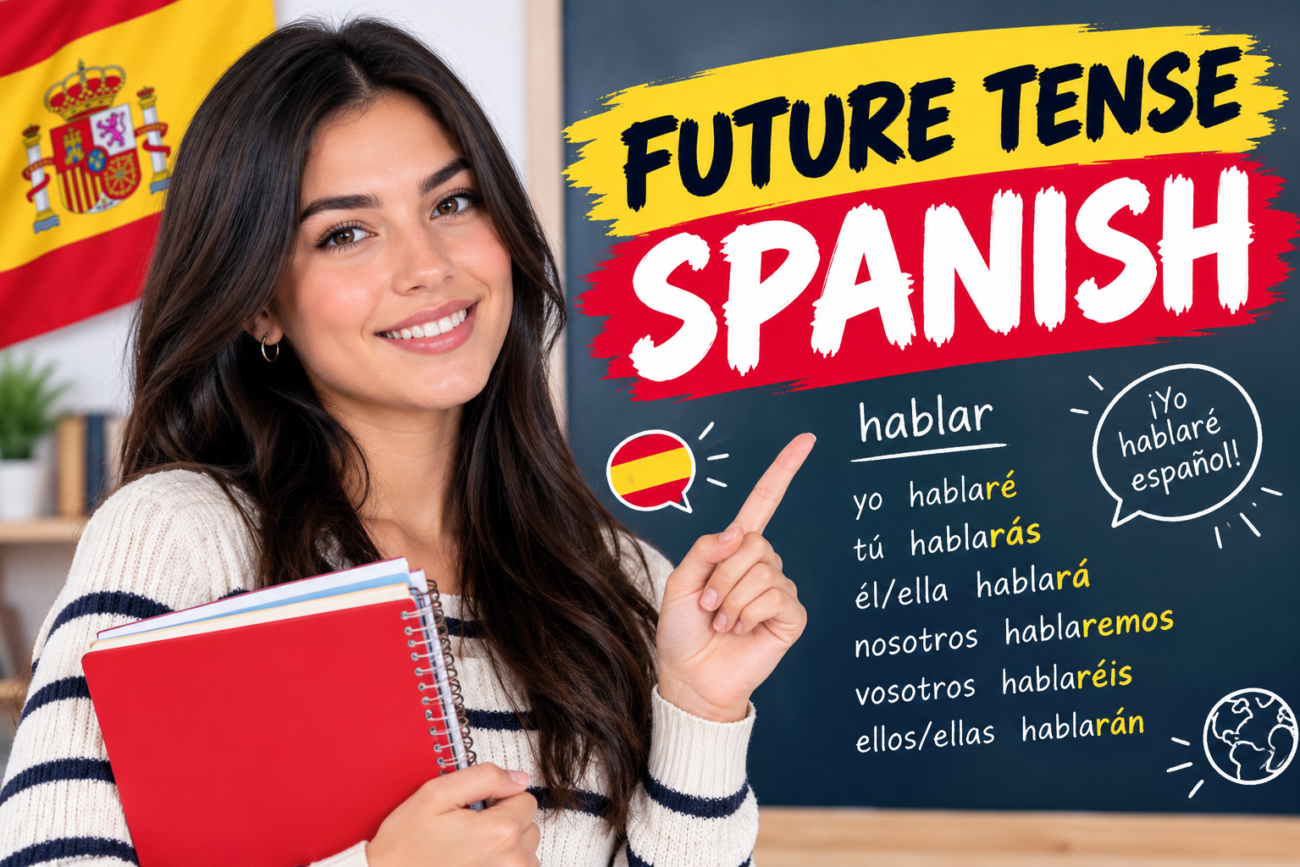
Learning the future tense in Spanish helps you talk about plans, make predictions, express intentions, and discuss what may happen later. Whether you are a beginner or improving your Spanish grammar, understanding how to form future-tense sentences makes everyday communication easier.
The future tense Spanish learners most commonly study is the futuro simple, also called the simple future. One useful feature of this tense is that regular verbs follow a consistent pattern: you keep the entire infinitive and add the appropriate future ending.
For example, hablar means “to speak.” In the simple future, hablaré means “I will speak.” The same basic pattern works with many other verbs, including comer (to eat) and vivir (to live).
This guide explains Spanish future tense rules, regular and irregular conjugations, common uses, sentence examples, and the differences between the simple future and other ways to discuss the future. You will also find practical exercises to help you apply what you learn.
Key Takeaways
- The Spanish simple future describes future actions, predictions, promises, and possibilities.
- Regular verbs keep their infinitive endings and add future-tense endings.
- The endings are the same for verbs ending in -ar, -er, and -ir.
- Irregular future verbs change their stems but generally keep the regular future endings.
- Spanish speakers also use ir a + infinitive to discuss planned or expected future actions.
- The simple future can express probability about the present, not just events that have yet to happen.
What Is the Future Tense in Spanish?
The Spanish future tense is used to describe actions and events that will happen after the present moment. Its grammatical name is futuro simple or futuro imperfecto in traditional Spanish grammar.
Consider these examples:
- Mañana estudiaré español. — Tomorrow, I will study Spanish.
- El próximo año viajaremos a España. — Next year, we will travel to Spain.
- Ella tendrá más tiempo mañana. — She will have more time tomorrow.
In each sentence, the verb communicates an action or situation expected in the future.
Spanish also has other ways to talk about future events. For example, Voy a estudiar means “I am going to study.” Although both estudiaré and voy a estudiar can refer to future actions, they may differ in emphasis and context.
Understanding when to use each construction will help you speak and write more naturally.
Spanish Future Tense Conjugation Rules
The simple future is relatively straightforward because regular verbs share the same endings, regardless of whether their infinitives end in -ar, -er, or -ir.
Future Tense Endings in Spanish
Memorize these six endings to conjugate regular verbs in the simple future.
| Subject pronoun | Future ending | English meaning |
|---|---|---|
| Yo | -é | I will |
| Tú | -ás | You will |
| Él / Ella / Usted | -á | He, she, or you will |
| Nosotros / Nosotras | -emos | We will |
| Vosotros / Vosotras | -éis | You all will |
| Ellos / Ellas / Ustedes | -án | They or you all will |
The endings contain accent marks in every form except nosotros. These accents are important for correct spelling and pronunciation.
In much of Latin America, speakers generally use ustedes instead of vosotros for the plural “you.” In Spain, vosotros is common in informal plural conversation, while ustedes is used in formal contexts.
How to Conjugate Regular Spanish Verbs
Follow these three steps:
- Start with the complete infinitive, such as hablar, comer, or vivir.
- Keep the infinitive unchanged.
- Add the ending that matches the subject.
Unlike the present tense, you do not remove -ar, -er, or -ir before adding the future ending.
For example, the infinitive comer becomes comeré, not comé.
Conjugation of Hablar, Comer, and Vivir
The following table shows how three common regular verbs change in the simple future.
| Subject | Hablar (to speak) | Comer (to eat) | Vivir (to live) |
|---|---|---|---|
| Yo | hablaré | comeré | viviré |
| Tú | hablarás | comerás | vivirás |
| Él / Ella / Usted | hablará | comerá | vivirá |
| Nosotros / Nosotras | hablaremos | comeremos | viviremos |
| Vosotros / Vosotras | hablaréis | comeréis | viviréis |
| Ellos / Ellas / Ustedes | hablarán | comerán | vivirán |
Notice that the infinitive remains intact in every form. Once you learn the endings, you can apply the same pattern to many regular Spanish verbs.
For example:
- Trabajaré mañana. — I will work tomorrow.
- Aprenderás mucho. — You will learn a lot.
- Escribiremos una carta. — We will write a letter.
- Abrirán la tienda temprano. — They will open the store early.
How to Use the Spanish Future Tense
The simple future has several common uses. Recognizing the meaning of a sentence helps you decide whether this tense is appropriate.
1. Talking About Future Actions
Use the simple future to describe an action that will take place later.
Examples:
- Mañana llamaré a mi madre. — Tomorrow, I will call my mother.
- El lunes empezaremos el proyecto. — On Monday, we will start the project.
- Mis amigos llegarán esta noche. — My friends will arrive tonight.
Time expressions such as mañana (tomorrow), la próxima semana (next week), and el próximo año (next year) often appear with the future tense.
However, a time expression alone does not determine the tense. The surrounding context and intended meaning also matter.
2. Making Predictions
Use the future tense to predict events or describe what you expect to happen.
Examples:
- Mañana hará frío. — It will be cold tomorrow.
- El equipo ganará el partido. — The team will win the match.
- Creo que ella aprobará el examen. — I think she will pass the exam.
Words such as creo que (I think that) and probablemente (probably) can help express the speaker’s degree of confidence.
For instance, Probablemente lloverá esta tarde means “It will probably rain this afternoon.”
3. Expressing Promises and Intentions
The simple future can communicate promises, commitments, and decisions about what someone will do.
Examples:
- Te ayudaré con la tarea. — I will help you with the homework.
- Nunca olvidaré tu amabilidad. — I will never forget your kindness.
- Te llamaré cuando llegue. — I will call you when I arrive.
In the final example, the main clause uses the future tense, while the clause introduced by cuando uses the present subjunctive. This is a common Spanish pattern when referring to a future event that has not yet occurred.
4. Expressing Probability in the Present
One distinctive feature of the Spanish simple future is its use to express conjecture or probability about the present.
Examples:
- ¿Dónde estará Ana? — Where could Ana be?
- Serán las ocho. — It must be around eight o’clock.
- Estará en casa ahora. — He or she is probably at home now.
These sentences do not necessarily refer to the future. Instead, the speaker is making an educated guess about what is happening now.
This usage is important because translating every future-tense verb with the English word “will” may not preserve the intended meaning.
Irregular Verbs in the Spanish Future Tense
Not every Spanish verb follows the regular pattern exactly. Some common verbs change their stems before the future endings are added.
The good news is that most irregular future verbs still use the same six endings:
-é, -ás, -á, -emos, -éis, -án
The main task is learning the irregular stem.
Common Irregular Future Verb Stems
| Infinitive | Meaning | Future stem | Example |
|---|---|---|---|
| Tener | To have | tendr- | tendré |
| Venir | To come | vendr- | vendré |
| Poner | To put | pondr- | pondré |
| Salir | To leave | saldr- | saldré |
| Poder | To be able to | podr- | podré |
| Saber | To know | sabr- | sabré |
| Querer | To want | querr- | querré |
| Hacer | To do or make | har- | haré |
| Decir | To say or tell | dir- | diré |
| Haber | To have, auxiliary verb | habr- | habrá |
For example, tener changes to the stem tendr- before the future ending is added. Therefore, “I will have” is tendré.
Similarly, hacer changes to har-, producing haré, which means “I will do” or “I will make.”
Examples of Irregular Future Verbs
- Tendré más tiempo mañana. — I will have more time tomorrow.
- Vendrán a cenar esta noche. — They will come for dinner tonight.
- Podrás hacerlo. — You will be able to do it.
- Haremos una pausa. — We will take a break.
- Diré la verdad. — I will tell the truth.
- Habrá mucha gente en el concierto. — There will be many people at the concert.
Notice that the irregularity usually affects the stem rather than the ending. Once you memorize the stem changes, you can conjugate these verbs using the same ending pattern as regular verbs.
Spanish Future Tense Examples With English Translations
Examples in context make it easier to recognize the future tense and use it in conversation.
Everyday Conversation
| Spanish sentence | English translation |
|---|---|
| Te veré mañana. | I will see you tomorrow. |
| Prepararé la cena. | I will prepare dinner. |
| ¿Vendrás conmigo? | Will you come with me? |
| No tendremos suficiente tiempo. | We will not have enough time. |
| Mis padres viajarán el viernes. | My parents will travel on Friday. |
School and Work
| Spanish sentence | English translation |
|---|---|
| Estudiaré para el examen. | I will study for the exam. |
| Terminaremos el informe mañana. | We will finish the report tomorrow. |
| El profesor explicará la lección. | The teacher will explain the lesson. |
| Aprenderás nuevas habilidades. | You will learn new skills. |
Travel and Plans
| Spanish sentence | English translation |
|---|---|
| Visitaremos Madrid el próximo verano. | We will visit Madrid next summer. |
| Reservaré una habitación. | I will book a room. |
| ¿A qué hora saldrá el tren? | What time will the train leave? |
| Llegaremos al aeropuerto temprano. | We will arrive at the airport early. |
These examples demonstrate how the simple future works in everyday situations. You can replace the verbs, subjects, or time expressions to create new sentences of your own.
Negative Sentences in the Spanish Future Tense
To make a future-tense sentence negative, place no directly before the conjugated verb.
The verb itself does not change.
Examples:
- No trabajaré mañana. — I will not work tomorrow.
- Ella no vendrá a la fiesta. — She will not come to the party.
- No tendremos clases el domingo. — We will not have classes on Sunday.
- Ellos no podrán asistir. — They will not be able to attend.
Spanish also uses other negative words, such as nunca (never) and jamás (never), when appropriate.
For example, Nunca olvidaré este día means “I will never forget this day.”
How to Ask Questions in the Spanish Future Tense
Spanish does not require an auxiliary verb equivalent to English “will” to form a simple future-tense question. You can generally use the future-tense verb in a question, adjusting word order and intonation as appropriate.
Written questions begin with an inverted question mark and end with a regular question mark.
Examples:
- ¿Estudiarás mañana? — Will you study tomorrow?
- ¿Vendrá Juan a la reunión? — Will Juan come to the meeting?
- ¿Qué harás este fin de semana? — What will you do this weekend?
- ¿Cuándo llegarán tus amigos? — When will your friends arrive?
- ¿Podremos terminar a tiempo? — Will we be able to finish on time?
Common question words include:
- Qué — What
- Cuándo — When
- Dónde — Where
- Cómo — How
- Quién — Who
- Por qué — Why
For example, ¿Dónde vivirás el próximo año? means “Where will you live next year?”
Spanish Simple Future vs. Ir a + Infinitive
Spanish speakers use both the simple future and the construction ir a + infinitive to discuss future events.
The construction ir a + infinitive literally means “to go to” followed by another verb, but it commonly expresses “going to do something.”
Comparing the Two Forms
| Simple future | Ir a + infinitive | English meaning |
|---|---|---|
| Estudiaré. | Voy a estudiar. | I will study / I am going to study. |
| Comerás. | Vas a comer. | You will eat / You are going to eat. |
| Lloverá. | Va a llover. | It will rain / It is going to rain. |
| Viajaremos. | Vamos a viajar. | We will travel / We are going to travel. |
When Should You Use Each Form?
The simple future is useful for predictions, promises, more formal statements, and general statements about future events.
The ir a + infinitive construction is especially common in everyday conversation when discussing plans, intentions, or events that seem likely based on the current situation.
For example:
- Voy a visitar a mi abuela mañana. — I am going to visit my grandmother tomorrow.
- Te ayudaré cuando lo necesites. — I will help you when you need it.
These are tendencies, not strict rules. Both constructions can overlap, and the best choice depends on context, emphasis, and regional usage.
Common Mistakes to Avoid
Learning the future tense becomes easier when you recognize a few frequent errors.
1. Removing the Infinitive Ending
Incorrect: Yo hablaré written as Yo hablé when you mean “I will speak.”
Correct: Yo hablaré.
The form hablé means “I spoke” in the preterite past tense. Keep the infinitive intact when forming the regular simple future.
2. Forgetting Accent Marks
Incorrect: hablaras when you mean “you will speak.”
Correct: hablarás.
Accent marks distinguish several future forms from other Spanish words or verb forms. Practice writing them correctly.
3. Using the Wrong Future Ending
Incorrect: Nosotros comerán.
Correct: Nosotros comeremos.
The ending must agree with the subject. Nosotros takes -emos, while ellos takes -án.
4. Applying Regular Stems to Irregular Verbs
Incorrect: teneré.
Correct: tendré.
Some common verbs require a changed stem. Learn irregular verbs in small groups and practice them in complete sentences.
5. Assuming Every Future Form Refers to the Future
The sentence Serán las diez usually means “It must be around ten o’clock,” rather than “It will be ten o’clock.”
Always consider the context before translating the future tense.
Practice Exercises: Test Your Spanish Future Tense
Complete the following sentences by putting the verb in parentheses into the simple future.
- Mañana yo ______ español. (estudiar)
- Ella ______ a la fiesta. (venir)
- Nosotros ______ la cena. (preparar)
- ¿Tú ______ ayudarme? (poder)
- Ellos ______ una casa nueva. (tener)
- Mi hermano ______ la verdad. (decir)
- No ______ mañana. (trabajar, yo)
- ¿Cuándo ______ ustedes? (llegar)
Answer Key
- estudiaré — Tomorrow I will study Spanish.
- vendrá — She will come to the party.
- prepararemos — We will prepare dinner.
- podrás — Will you be able to help me?
- tendrán — They will have a new house.
- dirá — My brother will tell the truth.
- trabajaré — I will not work tomorrow.
- llegarán — When will you arrive?
For the negative sentence in exercise seven, remember to include no: No trabajaré mañana.
Frequently Asked Questions
1. What Is the Future Tense in Spanish?
The future tense in Spanish expresses actions, events, or situations that will happen later. The simple future is formed by adding endings to the infinitive or, for irregular verbs, to a modified stem.
2. What Are the Six Spanish Future Tense Endings?
The six endings are -é, -ás, -á, -emos, -éis, and -án. Regular verbs ending in -ar, -er, and -ir all use these endings.
3. How Do You Form the Future Tense in Spanish?
For regular verbs, keep the complete infinitive and add the appropriate ending. For example, hablar becomes hablaré, comer becomes comeré, and vivir becomes viviré.
4. What Are the Most Common Irregular Future Verbs in Spanish?
Common irregular verbs include tener, venir, poder, poner, salir, hacer, decir, querer, and saber. Their stems change, but they generally use the standard future endings.
5. What Is the Difference Between the Simple Future and Ir a + Infinitive?
The simple future uses forms such as hablaré (“I will speak”), while ir a + infinitive uses forms such as voy a hablar (“I am going to speak”). Both can describe future events, but the second construction is especially common for plans and intentions in everyday conversation.
6. Can the Spanish Future Tense Express Probability?
Yes. The simple future can express a guess about the present. For example, Estará en casa can mean “He or she is probably at home,” depending on the context.
7. Do You Need a Separate Word for “Will” in Spanish?
No. Spanish normally expresses “will” through the conjugated future-tense verb. For example, comeré means “I will eat,” so you do not need to add a separate word corresponding to English “will.”
8. Is the Spanish Future Tense Difficult to Learn?
The regular future tense is generally manageable because all three verb groups share the same endings. The main challenges are remembering accent marks, learning irregular stems, and recognizing when the future tense expresses probability rather than a future event.
Conclusion
The Spanish future tense gives you a practical way to discuss plans, predictions, promises, and possibilities. Its regular conjugation pattern is straightforward: keep the infinitive and add one of six endings. Once you learn common irregular stems, you can use a wide range of verbs with confidence.
Remember that the simple future is not the only way to talk about what comes next. The construction ir a + infinitive is also widely used, particularly for plans and intentions. Understanding both forms will help you recognize natural Spanish in conversation and choose the right expression for your meaning.
To make steady progress, practice a few regular and irregular verbs each day, write your own example sentences, and review the exercises in this guide. With consistent practice, you will become more comfortable using the future tense in Spanish for everyday communication.
