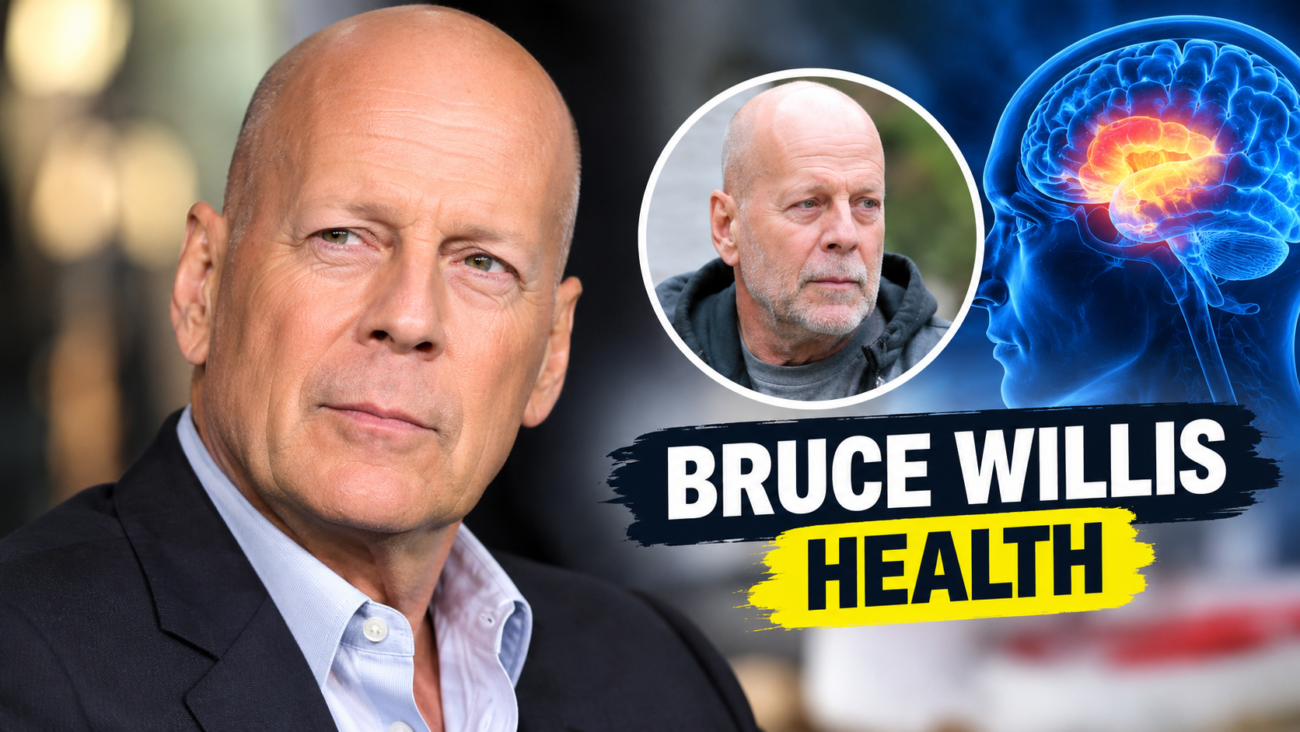
Bruce Willis health has been a subject of widespread public interest since his family first announced that the actor was stepping away from acting because of aphasia in 2022. The following year, his family clarified that his condition had progressed and that he had been diagnosed with frontotemporal dementia (FTD).
Because health information about a public figure can easily become mixed with rumors and speculation, it is important to separate documented information from unverified claims. The Willis family has shared some details about his condition, while his wife, Emma Heming Willis, has continued to discuss caregiving and raise awareness about FTD.
As of 2026, the publicly confirmed picture is that Bruce Willis is living with frontotemporal dementia, a neurodegenerative condition that can affect language, behavior, movement, and other aspects of functioning. His family continues to support him while also using their experience to promote greater understanding of the disease.
Key Takeaways
- Bruce Willis was initially diagnosed with aphasia in 2022, prompting his retirement from acting.
- His family announced a more specific diagnosis of frontotemporal dementia (FTD) in February 2023.
- FTD affects areas of the brain associated with language, behavior, personality, and movement.
- His family has described adapting the way they communicate with him as his condition has progressed.
- Emma Heming Willis has become an advocate for FTD awareness, caregiver support, and research.
- Recent public updates have focused largely on family life, caregiving, and FTD awareness rather than detailed medical information about Bruce himself.
Biography Table
| Detail | Information |
|---|---|
| Full Name | Walter Bruce Willis |
| Date of Birth | March 19, 1955 |
| Age | 71 as of 2026 |
| Birthplace | Idar-Oberstein, West Germany |
| Nationality | American |
| Profession | Actor, producer, musician |
| Education | Montclair State University; he left before graduating |
| Years Active | 1980s–2022 |
| Known For | Die Hard, Moonlighting, Pulp Fiction, The Sixth Sense, Armageddon |
| Major Achievements | Emmy Awards, Golden Globe Award, and a long career in film and television |
Bruce Willis Health: What Is Confirmed?
The most important confirmed fact about Bruce Willis health is his diagnosis of frontotemporal dementia.
In March 2022, Willis’s family announced that he had been diagnosed with aphasia, a condition that can affect a person’s ability to communicate through speech and language. His family said the diagnosis was affecting his cognitive abilities and that he would be stepping away from acting.
In February 2023, the family provided a further update. They said his condition had progressed and that doctors had reached a more specific diagnosis: frontotemporal dementia, commonly abbreviated as FTD.
This distinction matters because aphasia describes a communication-related symptom or disorder, whereas frontotemporal dementia is a broader neurodegenerative condition that can produce communication difficulties alongside other symptoms.
What Is Frontotemporal Dementia?
Frontotemporal dementia is a group of disorders involving degeneration of the frontal and temporal regions of the brain.
These areas play important roles in functions such as:
- Language and communication
- Behavior
- Personality
- Decision-making
- Social interaction
- Movement
According to the Association for Frontotemporal Degeneration, FTD is particularly important in younger-onset dementia because it is the most common form of dementia among people under 60. The condition can also affect people at older ages.
FTD does not necessarily look the same in every person. Some people experience prominent language problems, while others may initially develop behavioral or personality changes. Movement problems can also occur.
That variation is one reason it is not appropriate to assume that every person with FTD will experience the same progression.
How Did Aphasia Relate to Bruce Willis’s Diagnosis?
Aphasia was the first publicly disclosed diagnosis associated with Bruce Willis’s retirement.
Aphasia can affect the ability to speak, understand language, read, or write. It can have different causes, including neurological conditions.
In Willis’s case, his family initially described communication difficulties. As additional symptoms emerged, the family later announced that doctors had identified frontotemporal dementia as the underlying diagnosis.
The progression from an initial aphasia diagnosis to an FTD diagnosis also illustrates why identifying the cause of neurological symptoms can sometimes take time.
How Has Bruce Willis’s Condition Affected His Acting Career?
Bruce Willis retired from acting in 2022 following the announcement about his aphasia diagnosis.
His retirement marked the end of a career spanning decades. Willis became internationally recognized through television’s Moonlighting before becoming one of Hollywood’s best-known film stars.
His major film credits include:
- Die Hard
- Pulp Fiction
- The Sixth Sense
- Armageddon
- The Fifth Element
- Unbreakable
- Looper
Communication and cognitive difficulties associated with his condition made continuing a demanding acting career increasingly difficult. His family ultimately prioritized his health and well-being over his professional work.
What Have His Family Members Shared?
Bruce Willis’s family has played an important role in communicating verified information about his health.
His wife, Emma Heming Willis, has spoken publicly about the realities of caregiving and the need to adapt as FTD progresses. She has also discussed explaining the diagnosis to their daughters in an age-appropriate and honest way.
The family is a blended one. Bruce has five daughters: three with former wife Demi Moore and two with Emma Heming Willis.
Publicly shared family moments have also shown that his relatives continue to spend time with him. In 2025, for example, Tallulah Willis shared photographs from a family gathering that included moments with her father.
These personal moments provide context, but they should not be interpreted as medical assessments of his condition.
What Has Emma Heming Willis Said About His Condition?
Emma Heming Willis has increasingly focused on caregiving and FTD advocacy.
In public discussions, she has explained that communication with Bruce has changed and that the family has learned to connect with him in different ways. She has also spoken about the importance of supporting caregivers, who can face significant emotional and practical challenges.
In a 2025 interview reported by People, Heming Willis discussed anosognosia, a neurological symptom involving impaired awareness of one’s own illness. She said she believed Bruce had not fully connected the diagnosis with his own condition.
It is important to distinguish these comments from a complete medical record. The public does not have access to Bruce Willis’s private clinical information, test results, treatment records, or detailed prognosis.
Is Bruce Willis Still Receiving Care?
Bruce Willis continues to receive care, according to public comments from his family.
Emma Heming Willis has described herself as a caregiver and has spoken about adapting their home and family routines to his needs. Recent reporting has also described efforts to give Bruce a calm living environment while maintaining a more typical home routine for their younger daughters.
Care for someone with FTD can involve much more than medical appointments. Depending on the individual’s symptoms, families may need to address communication, daily activities, safety, behavioral changes, mobility, and emotional support.
The exact details of Bruce Willis’s personal care arrangements remain private.
Is There a Cure for Frontotemporal Dementia?
There is currently no cure for FTD and no established treatment that stops or reverses the underlying neurodegeneration.
The Association for Frontotemporal Degeneration states that there are currently no disease-modifying treatments that slow or stop FTD. Research continues to investigate potential treatments and ways to improve care and quality of life.
Treatment and support can nevertheless focus on managing individual symptoms and helping the person and family maintain quality of life.
Depending on a person’s needs, care may involve professionals such as:
- Neurologists
- Speech-language therapists
- Occupational therapists
- Physical therapists
- Mental health professionals
- Social workers
- Specialized dementia-care teams
The appropriate approach varies from person to person.
Why Has Bruce Willis’s Diagnosis Raised Awareness of FTD?
FTD has historically received less public attention than some other forms of dementia. Bruce Willis’s diagnosis helped bring the condition to a much larger audience.
His family’s decision to speak publicly about the diagnosis has also contributed to awareness campaigns and fundraising efforts.
In March 2026, Emma Heming Willis was honored at the Association for Frontotemporal Degeneration’s Hope Rising Benefit. At the event, she announced the Emma & Bruce Willis Fund for Dementia Research and Caregiver Support, designed to support research, awareness, and caregivers affected by FTD.
The AFTD has described the Willis family’s advocacy as an important contribution to greater visibility for the condition.
What Should People Understand About His Recent Health Updates?
Recent public information should be interpreted carefully.
There have been occasional photographs, family posts, interviews, and statements about Bruce Willis. However, these do not provide a complete picture of his medical condition.
A reliable health update should ideally come from:
- Bruce Willis’s immediate family or authorized representatives.
- Reputable news organizations reporting verified statements.
- Recognized medical or dementia organizations when discussing FTD itself.
Social media posts and anonymous claims should not be treated as medical evidence.
As of 2026, public reporting continues to confirm his FTD diagnosis and his family’s ongoing caregiving experience, but detailed information about his day-to-day medical status remains private.
Bruce Willis Health and His Family’s Support
One of the clearest themes in the family’s public statements has been the importance of maintaining close family connections.
Bruce’s former wife, Demi Moore, has continued to describe him as part of the family, while his daughters have publicly shared affectionate messages and family moments.
This blended-family support has become an important part of the story surrounding his illness. It also reflects a broader reality of dementia care: the effects of a neurodegenerative condition extend beyond the person diagnosed and can significantly affect spouses, children, relatives, and caregivers.
Emma Heming Willis has repeatedly emphasized the value of community and support for families dealing with FTD.
Bruce Willis’s Health Journey in Context
The publicly documented timeline can be summarized as follows:
| Year | Health-related development |
|---|---|
| 2022 | His family announced an aphasia diagnosis and his retirement from acting. |
| 2023 | His family announced that the diagnosis had progressed to frontotemporal dementia. |
| 2024–2025 | Emma Heming Willis increasingly spoke publicly about caregiving and FTD awareness. |
| 2025 | Family members continued sharing occasional personal moments involving Bruce. |
| 2026 | Emma Heming Willis continued advocacy work and helped launch a fund supporting FTD research and caregivers. |
This timeline separates confirmed public announcements from speculation about his private medical circumstances.
Why Accurate Information About Bruce Willis Health Matters
Celebrity health stories can attract enormous attention, but neurological diseases deserve careful reporting.
FTD is not simply another name for ordinary age-related memory loss. It involves specific areas of the brain and can produce prominent changes in language, behavior, personality, or movement.
At the same time, no public article can fully describe Bruce Willis’s individual medical experience because his detailed medical records remain private.
The most responsible approach is therefore to report what his family has confirmed and use established medical information to explain the condition without making assumptions about symptoms or prognosis that have not been publicly documented.
Frequently Asked Questions
What disease does Bruce Willis have?
Bruce Willis was diagnosed with frontotemporal dementia (FTD). His family announced the diagnosis in February 2023 after initially revealing an aphasia diagnosis in 2022.
When was Bruce Willis diagnosed with aphasia?
His family publicly announced his aphasia diagnosis in March 2022. The diagnosis was associated with communication difficulties and preceded his retirement from acting.
What is frontotemporal dementia?
Frontotemporal dementia is a group of neurodegenerative disorders affecting the frontal and temporal regions of the brain. It can affect language, behavior, personality, and movement.
Is there a cure for Bruce Willis’s condition?
There is currently no cure for frontotemporal dementia and no disease-modifying treatment established to stop or reverse the underlying disease process. Research into potential treatments is ongoing.
Is Bruce Willis still acting?
No. Bruce Willis retired from acting in 2022 after his family announced his aphasia diagnosis. His health condition subsequently received the more specific FTD diagnosis.
Does Bruce Willis have Alzheimer’s disease?
His publicly announced diagnosis is frontotemporal dementia, not Alzheimer’s disease. FTD is a distinct group of neurodegenerative disorders, although both conditions can cause cognitive and functional changes.
How is Bruce Willis doing now?
As of 2026, public information confirms that Bruce Willis continues to live with FTD and receive family support. His relatives have shared some personal updates, but detailed medical information about his current condition remains private.
Who is caring for Bruce Willis?
Emma Heming Willis has publicly discussed her role as a caregiver, while Bruce’s children and extended family have remained involved in his life. The precise details of his professional and medical care have not been publicly disclosed.
Conclusion
Bruce Willis health has changed dramatically since his family first announced his aphasia diagnosis in 2022. In 2023, the family confirmed that his condition had progressed to frontotemporal dementia, providing a clearer explanation for the neurological challenges he was experiencing.
Since then, the focus has increasingly shifted from his Hollywood career to his family, caregiving, and raising awareness about FTD. Emma Heming Willis and other members of the Willis family have used their public platforms to encourage greater understanding of the disease and stronger support for caregivers.
The most important distinction when following Bruce Willis’s health is between confirmed information and speculation. His FTD diagnosis is publicly established, but many details of his personal medical care remain private. For that reason, trustworthy updates should rely on statements from his family and established reporting rather than unverified social media claims.
His family’s advocacy has also helped bring greater public attention to a disease that remains poorly understood and without a cure. In 2026, their continued work includes supporting research and caregivers through the Emma & Bruce Willis Fund, extending the family’s efforts beyond their own experience.
