Introduction
If you are searching for marathon steam charts, you are probably trying to understand how many people are playing Bungie’s extraction shooter on PC and how its player population has changed since launch.
Marathon launched on Steam on March 5, 2026. Since then, its concurrent-player numbers have moved significantly, with major spikes around launch and later content updates. Steam Charts and SteamDB provide useful ways to track those changes, although the figures represent Steam activity rather than the game’s entire player base across every platform.
The most important point is that a single live player count does not tell the whole story. Looking at daily peaks, monthly averages, historical highs, and changes following updates gives a much better picture of Marathon’s activity on Steam.
This guide explains how to read the charts, reviews the major player-count milestones, and examines the trends visible through August 2026.
Key Takeaways
- Marathon released on Steam on March 5, 2026, and is developed and published by Bungie.
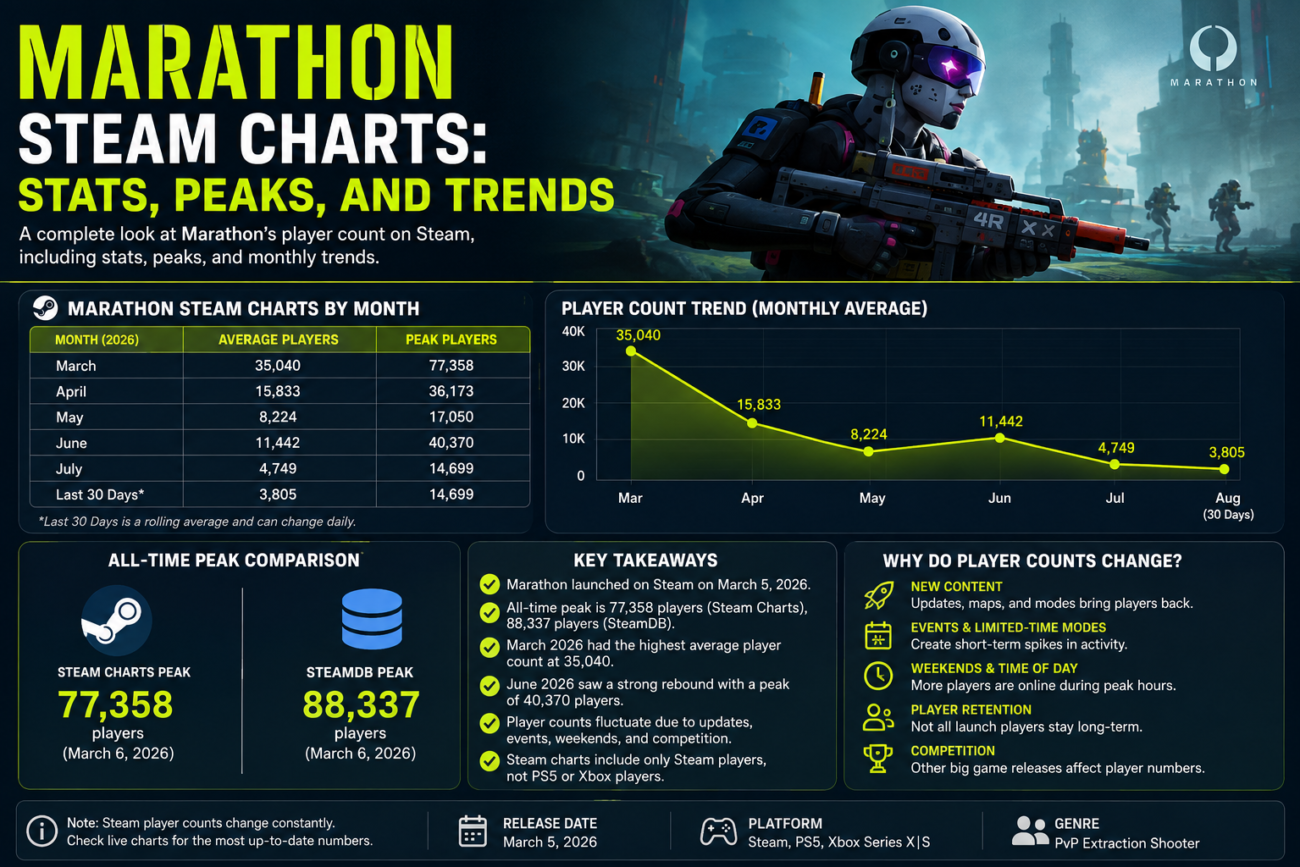
- Steam Charts currently lists an all-time concurrent peak of 77,358 players, while SteamDB records a higher peak of 88,337, illustrating why different tracking services can show different historical figures.
- Steam Charts reports a March 2026 average of about 35,040 concurrent players, followed by lower monthly averages in April and May.
- June produced a significant rebound, with Steam Charts recording an average of about 11,442 players and a peak of 40,370.
- July and August showed lower Steam activity than June, although individual updates have produced noticeable short-term spikes.
- Steam numbers should not be treated as the total Marathon population because the game is also available on PlayStation 5 and Xbox Series X|S.
Main Article
What Are the Marathon Steam Charts?
The term marathon steam charts generally refers to websites and tracking tools that monitor the number of people playing Marathon concurrently through Steam.
Unlike a total-sales figure, concurrent player count measures how many players are online at approximately the same time. This makes it particularly useful for multiplayer games.
Several measurements can appear on a Steam player chart:
| Metric | What It Means |
|---|---|
| Current players | Players online at the time of measurement |
| 24-hour peak | Highest concurrent player count during the previous 24 hours |
| Monthly average | Average concurrent player count during a month |
| Monthly peak | Highest concurrent count recorded during a month |
| All-time peak | Highest concurrent count recorded since tracking began |
These measurements answer different questions.
For example, the current count can tell you how active the game is right now, while the monthly average gives a broader picture of regular Steam activity.
When Did Marathon Launch on Steam?
Bungie released Marathon worldwide on March 5, 2026. The game launched on Steam alongside PlayStation 5 and Xbox Series X|S versions.
On Steam, Marathon is an online PvP extraction shooter set on Tau Ceti IV. Players take the role of Runners who explore maps, collect valuable resources, encounter AI threats and compete against other players before attempting to extract.
Because the game is cross-platform, Steam charts provide only one part of the overall player-population picture.
That distinction is important when interpreting the numbers.
Marathon Steam Player Count and Historical Peak
The highest number shown depends on which tracking service you use.
Steam Charts currently lists an all-time peak of 77,358 concurrent Steam players, while SteamDB reports an 88,337-player peak on March 6, 2026.
The discrepancy demonstrates why readers should identify the source before comparing numbers.
Third-party chart websites can also differ because of data collection methods, updates, rounding, or historical-data handling. For that reason, it is better to use one source consistently when measuring changes over time.
The broader takeaway is clear: Marathon attracted its largest Steam audience around launch.
Marathon Steam Charts by Month
The monthly figures provide a clearer view of how Steam activity developed after release.
According to Steam Charts, the following figures illustrate the trend:
| Month | Average Players | Peak Players |
|---|---|---|
| March 2026 | 35,040 | 77,358 |
| April 2026 | 15,833 | 36,173 |
| May 2026 | 8,224 | 17,050 |
| June 2026 | 11,442 | 40,370 |
| July 2026 | 4,749 | 14,699 |
| Last 30 Days* | 3,805 | 14,699 |
*The last-30-days figure is a rolling measurement and can change as new data enters the period.
The table shows three broad phases: a strong launch, a substantial post-launch decline, and a temporary rebound during June.
March: The Launch Surge
March was Marathon’s strongest month by average Steam activity in the Steam Charts data currently available.
The game averaged roughly 35,040 concurrent players, with a recorded peak of 77,358.
Launch-day numbers are naturally influenced by curiosity, existing fans, marketing, reviews, new-content interest, and players wanting to experience a game immediately.
Therefore, a launch peak should not automatically be treated as a sustainable baseline.
April: A Major Drop
April saw the average Steam player count fall to approximately 15,833, with a monthly peak of 36,173.
That represents a substantial reduction from March.
For multiplayer games, post-launch declines are common. The more meaningful question is what happens after the initial audience settles into a regular player base.
May: Another Decline
Steam Charts records May at approximately 8,224 average concurrent players, with a peak of 17,050.
Compared with the launch month, this was a considerable reduction in Steam activity.
However, the May figures should not be interpreted as the total number of people who owned or played Marathon. Concurrent-player statistics measure simultaneous activity, not unique players.
June: A Significant Rebound
June stands out because the downward trend temporarily reversed.
Steam Charts records an average of approximately 11,442 concurrent players and a peak of 40,370 during June.
SteamDB similarly shows June as a strong month, identifying a peak of roughly 40,686.
This illustrates why looking only at a game’s launch numbers can be misleading. New seasons, updates, events, balance changes, promotions, or other content can bring players back.
The June rebound was therefore an important moment in the Marathon player-count timeline.
July: Lower Average Activity
July brought another decline.
Steam Charts reports an average of approximately 4,749 concurrent Steam players and a peak of 14,699.
SteamDB’s monthly data similarly shows a substantial reduction from June’s peak.
The difference between June and July highlights the importance of distinguishing temporary event-driven spikes from sustained player retention.
August: What the Recent Trend Shows
Recent August data indicates that Steam activity has remained below the levels seen during launch and June.
One third-party tracking source reported an August average around 3,721 players with a recent peak of 6,298 in its available data.
Steam Charts’ rolling 30-day data has also shown an average in the low-thousands range.
These numbers can change quickly, particularly when updates, events, weekends, or other changes affect player behavior.
For that reason, a live count should always be treated as a snapshot rather than a permanent measure of the game’s popularity.
Why Do Marathon Steam Charts Change So Much?
Player counts for online games can fluctuate for many reasons.
New Content
Major updates can encourage inactive players to return. New maps, modes, weapons, progression systems, or seasonal content can create renewed interest.
Events and Limited-Time Modes
Limited-time experiences can generate short-term increases because players have an incentive to return before the event ends.
A good example came in July 2026, when Bungie’s Vault Breaker experimental PvE mode launched. PC Gamer reported that SteamDB charts showed Marathon climbing above 14,800 concurrent players shortly after the update went live.
Weekends and Time of Day
Concurrent players naturally vary throughout a day.
A chart captured at one moment can therefore look very different from another chart taken several hours later.
Player Retention
Launch excitement does not necessarily translate into long-term activity.
Some players may complete a game’s initial content, decide whether the gameplay loop suits them, and then either continue playing or move to another title.
Competition
Online multiplayer games compete for players’ time. Major releases, seasonal updates in other games, and popular live-service events can influence how many people are playing at any given moment.
How to Read Marathon Steam Charts Correctly
If you want to understand Marathon’s performance rather than simply find a number, look at several metrics together.
1. Check the Current Count
The current player figure tells you how many people are playing at the moment the data was captured.
It is useful, but highly volatile.
2. Check the 24-Hour Peak
The 24-hour peak provides more context by showing the busiest point of the previous day.
This helps prevent you from assuming that a low daytime count represents the game’s entire daily activity.
3. Look at the Monthly Average
The monthly average is generally more useful for identifying sustained trends.
For example, comparing March’s approximately 35,040 average with May’s approximately 8,224 average reveals a much larger change than looking at two random live snapshots.
4. Compare Monthly Peaks
Monthly peaks can reveal the impact of launches, updates, events, and weekends.
June’s approximately 40,370 peak, for instance, stands out against May’s 17,050 peak.
5. Watch the Direction of the Trend
A single number rarely tells the full story.
Instead, ask:
- Is the average increasing or decreasing?
- Are peaks becoming more frequent?
- Do updates produce temporary or sustained gains?
- Is the player count stabilizing?
- How does the current month compare with previous months?
This approach provides a more balanced interpretation.
Steam Charts vs. SteamDB
Two of the most commonly referenced sources for Marathon Steam statistics are Steam Charts and SteamDB.
Both track Steam activity, but their displayed historical figures can differ.
For example, Steam Charts currently lists a 77,358 all-time peak, while SteamDB lists 88,337.
That does not necessarily mean one source is automatically correct and the other is wrong. Differences can result from how each service collects, stores, updates, or presents historical data.
For consistent analysis, choose one tracker and use the same source when comparing different months.
Does Steam Player Count Equal Marathon’s Total Player Count?
No.
This is one of the most important limitations of marathon steam charts.
Marathon is available on Steam, PlayStation 5, and Xbox Series X|S.
Steam charts measure activity on Steam. They do not provide a complete count of players using PlayStation or Xbox.
Therefore, a Steam decline does not automatically prove that the game’s total global player population declined by the same percentage.
The Steam numbers are best described as an indicator of PC activity through Steam.
What the Current Trend Suggests
The historical data shows a recognizable pattern:
Launch → sharp decline → June rebound → later decline
March’s launch numbers were substantially higher than subsequent monthly averages. Activity then fell through April and May before recovering in June. By July and the available August data, Steam activity had again moved lower.
That pattern suggests that updates and new content can produce meaningful increases in player activity, but maintaining those gains over a longer period is a separate challenge.
It is also important not to describe the trend as a measure of the game’s overall health based solely on Steam. Cross-platform games require broader data to make a complete assessment.
What Makes a Player-Count Spike Meaningful?
Not every spike has the same significance.
A spike that lasts only a few hours may be associated with a specific event or update. A sustained increase in monthly average players is stronger evidence of improved ongoing engagement.
For example:
| Type of Change | What It May Indicate |
|---|---|
| One-hour spike | Event, update, or daily peak |
| Weekend increase | Normal scheduling effect |
| Short update spike | Returning players testing new content |
| Higher monthly average | More sustained engagement |
| Higher peaks and average together | Stronger evidence of broader activity |
This is why experienced chart analysis focuses on trends rather than one impressive number.
Why Steam Charts Matter for Marathon Players
Player-count data can be useful even if you are not interested in game-industry analysis.
For potential players, it can provide context about Steam activity.
For existing players, it can help identify whether major updates are attracting renewed interest.
For content creators, charts can provide useful background when discussing the game’s performance.
However, player count should not be the only factor in deciding whether to play.
Gameplay quality, matchmaking, server performance, community activity, updates, pricing, and personal preference all matter too.
Frequently Asked Questions
What is the Marathon Steam Charts peak?
Steam Charts currently lists an all-time concurrent peak of 77,358 players, while SteamDB reports 88,337. The difference reflects variations between tracking services.
How many people are playing Marathon on Steam?
The live number changes constantly. Recent Steam tracking data has placed the game’s concurrent Steam population in the low-thousands, so readers should check a live chart for the latest figure rather than relying on a fixed number.
When did Marathon release on Steam?
Marathon released on Steam on March 5, 2026, alongside its console release.
What was Marathon’s strongest month on Steam?
Based on Steam Charts’ available monthly data, March 2026 had the highest average concurrent Steam player count at approximately 35,040.
Did Marathon’s player count increase after an update?
Yes. June 2026 showed a substantial rebound, and the July Vault Breaker update also produced a notable short-term spike, with PC Gamer reporting SteamDB data above 14,800 concurrent players after the mode launched.
Do Steam charts include PlayStation and Xbox players?
No. Steam charts measure Steam activity. Marathon is also available on PlayStation 5 and Xbox Series X|S, so Steam numbers do not represent the complete player population across platforms.
Why are Marathon player counts different on different websites?
Different tracking services can display different figures because they may use different data collection, processing, and historical-record methods. Steam Charts and SteamDB, for example, currently show different all-time peaks for Marathon.
Is a declining Steam player count proof that Marathon is failing?
No. Steam activity is only one indicator, and Marathon is a cross-platform game. Player counts should be considered alongside updates, engagement, reviews, matchmaking, content releases, and activity on other platforms.
Conclusion
The marathon steam charts provide a useful window into how Marathon has performed on PC since its March 2026 launch.
The available data shows a strong launch period, a substantial decline during April and May, a meaningful rebound in June, and lower Steam activity through July and the available August figures.
The most useful way to interpret these numbers is to look beyond the current player count. Monthly averages, daily peaks, historical highs, and changes following major updates provide much better context.
At the same time, Steam statistics should never be treated as a complete measurement of Marathon’s global audience because the game also operates on PlayStation 5 and Xbox Series X|S.
For anyone following the game’s long-term trajectory, the most informative question is not simply “How many people are playing Marathon right now?” but rather “How are its player numbers changing over time, and how consistently do new updates bring players back?”
