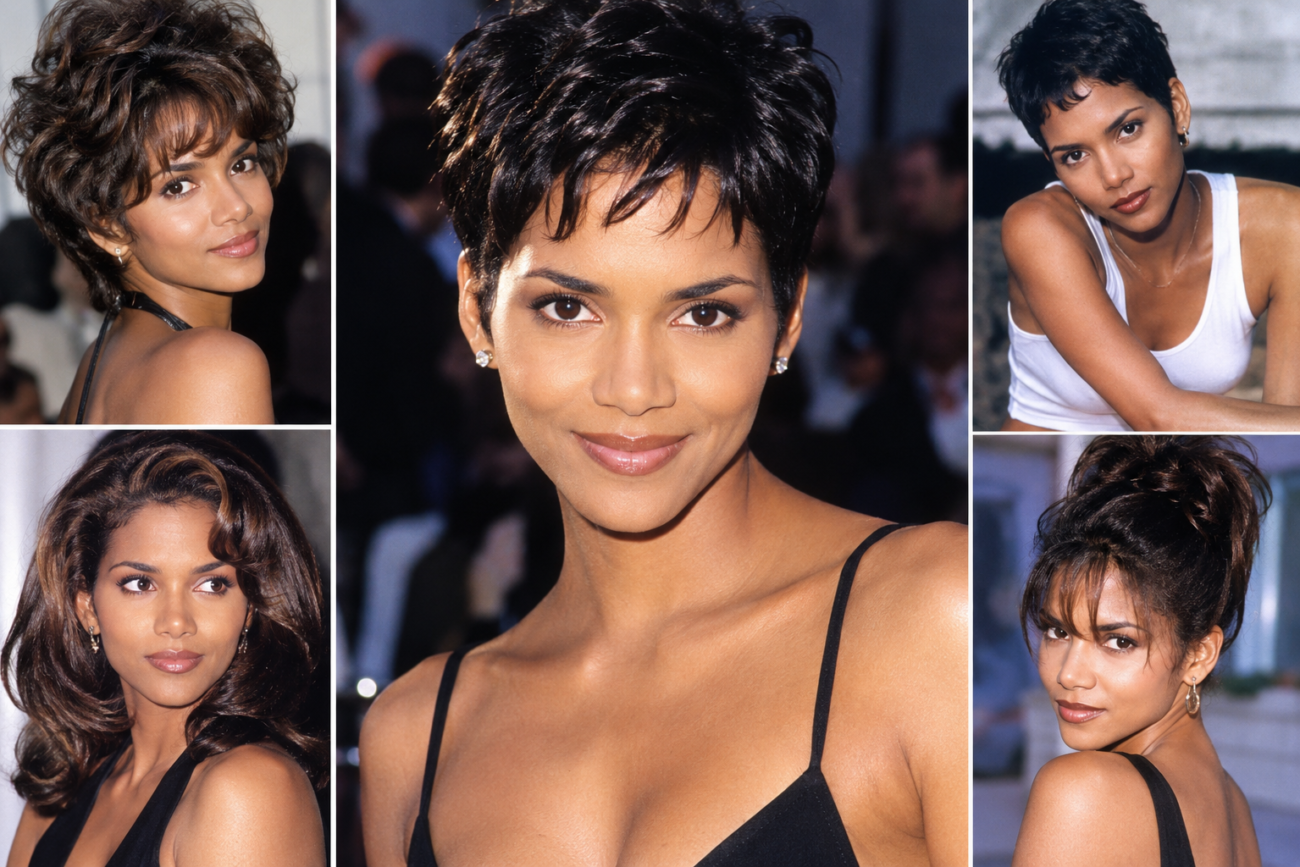
The halle berry 90s era was an important chapter in the career of one of Hollywood’s most recognizable actresses. During the decade, Halle Berry moved from promising supporting roles to major film projects and increasingly demanding performances.
Berry entered the 1990s after establishing herself in television and building a public profile through modeling and beauty competitions. Her film work soon expanded, beginning with roles in movies such as Jungle Fever and The Last Boy Scout. She later appeared opposite Eddie Murphy in Boomerang, starred in Losing Isaiah, took on action roles, and became part of films ranging from broad comedy to political satire.
The decade culminated with one of her most significant performances: portraying legendary performer Dorothy Dandridge in Introducing Dorothy Dandridge in 1999. That performance helped set the stage for the awards recognition and major roles that followed in the early 2000s.
Looking back at Halle Berry in the 90s therefore offers more than a nostalgia trip. It shows how an actress developed her screen presence, broadened her range, and positioned herself for the career-defining achievements that came next.
Key Takeaways
- Halle Berry’s 1990s career began with supporting and ensemble roles before she moved into more prominent parts.
- Jungle Fever (1991) and Boomerang (1992) were important early film appearances.
- Throughout the decade, Berry worked across comedy, drama, action, thriller, and television.
- Films such as Losing Isaiah, Executive Decision, Bulworth, and BAPS* demonstrated her range.
- Her performance in Introducing Dorothy Dandridge became one of the defining achievements of her late-1990s career.
- The 1990s helped establish the foundation for Berry’s major success in the 2000s.
Biography Table
| Detail | Information |
|---|---|
| Full Name | Halle Maria Berry |
| Date of Birth | August 14, 1966 |
| Age | 60 in 2026 |
| Birthplace | Cleveland, Ohio, United States |
| Nationality | American |
| Profession | Actress, producer, director |
| Education | Bedford High School; attended Cuyahoga Community College |
| Years Active | 1989–present |
| Known For | Boomerang, The Flintstones, Bulworth, Introducing Dorothy Dandridge, X-Men, Monster’s Ball |
| Major Achievements | Academy Award, Primetime Emmy Award, Golden Globe Award and other major honors |
| Estimated Net Worth | Not included because widely reported estimates vary and are not consistently verifiable |
Main Article
Halle Berry’s Career at the Start of the 1990s
Halle Berry began the 1990s as a young actress who was still establishing herself in Hollywood. Born in Cleveland, Ohio, in 1966, she had already gained attention through beauty pageants and modeling before moving into acting. The Television Academy identifies her as an American actress and notes that she had been a model and pageant contestant before her acting career developed.
One of her earliest major film appearances of the decade came in Spike Lee’s Jungle Fever in 1991. The film gave Berry an opportunity to work in a serious dramatic environment and placed her alongside an established ensemble cast.
She also appeared in The Last Boy Scout in 1991, expanding her experience into the action-thriller genre. These early roles were important because they introduced Berry to different kinds of film audiences.
Halle Berry in Boomerang in 1992
One of the most recognizable Halle Berry movies from the 90s is Boomerang, released in 1992.
Berry starred alongside Eddie Murphy in the romantic comedy, playing Angela Lewis. The film was directed by Reginald Hudlin and gave Berry a much more visible role than many of her earlier screen appearances.
The movie is particularly important when discussing her rise during the decade because it helped demonstrate that Berry could hold her own in a mainstream studio comedy alongside one of the era’s biggest stars.
The Television Academy describes Boomerang as Berry’s breakthrough film role and notes that it led to further opportunities in projects such as The Flintstones, Bulworth, and Introducing Dorothy Dandridge.
Exploring Halle Berry’s 90s Movies
Berry’s filmography during the decade was diverse. Rather than following one genre, she moved between romantic comedy, drama, action, thriller, and satire.
Some of her notable 1990s projects include:
| Year | Film | Genre/Style |
|---|---|---|
| 1991 | Jungle Fever | Drama |
| 1991 | The Last Boy Scout | Action thriller |
| 1992 | Boomerang | Romantic comedy |
| 1993 | CB4 | Comedy |
| 1993 | Father Hood | Comedy |
| 1994 | The Flintstones | Family comedy |
| 1995 | Losing Isaiah | Drama |
| 1996 | Executive Decision | Action thriller |
| 1996 | The Rich Man’s Wife | Thriller |
| 1997 | BAPS* | Comedy |
| 1998 | Bulworth | Political comedy |
| 1998 | Why Do Fools Fall in Love | Biographical drama |
| 1999 | Introducing Dorothy Dandridge | Television drama |
This range is one of the most interesting aspects of the halle berry 90s period. She was not confined to a single screen persona.
The Flintstones and Mainstream Recognition
In 1994, Berry appeared in The Flintstones, the live-action adaptation of the popular animated franchise.
She played Sharon Stone, the secretary of Fred Flintstone’s boss. The role was substantially different from her dramatic work and placed her in a large-scale mainstream comedy.
The movie exposed Berry to a broad family-oriented audience and became another notable entry in her 1990s filmography. Her career was increasingly moving between commercial entertainment and more serious dramatic projects.
Losing Isaiah Showed a More Dramatic Side
Berry took on a more serious role in Losing Isaiah in 1995, appearing alongside Jessica Lange.
The drama centered on a complicated adoption and custody dispute. Berry played Khaila Richards, a mother whose personal circumstances become central to the story.
The project gave Berry an opportunity to work in an emotionally demanding dramatic setting. It also reinforced a pattern that would continue throughout her career: moving between commercial movies and projects built around heavier dramatic material.
Action Roles in the Mid-1990s
Berry also became increasingly associated with action and thriller projects.
In 1996, she appeared in Executive Decision, an aviation thriller starring Kurt Russell. The film involved a terrorist hijacking and a high-stakes attempt to regain control of an aircraft.
That same year, Berry appeared in The Rich Man’s Wife, a psychological thriller.
These projects broadened the types of roles associated with her during the decade. Her 1990s filmography increasingly included characters situated in stories involving danger, crime, suspense, and action.
BAPS* and Comedy in 1997
In 1997, Berry starred with Natalie Desselle Reid in BAPS*, directed by Robert Townsend.
The comedy followed two friends who travel from Georgia to Los Angeles hoping to pursue careers as dancers but become involved in an unexpected situation involving a wealthy man.
The movie showcased a lighter side of Berry’s screen work. It also demonstrated that her 1990s career was not built exclusively around serious drama or conventional Hollywood glamour.
Bulworth in 1998
Berry’s 1998 film Bulworth represented another shift in tone.
Directed by and starring Warren Beatty, the political comedy focused on a politician undergoing a personal and professional crisis. Berry played Nina, a woman who becomes closely connected to Beatty’s character.
The film was notable because it combined comedy with social and political commentary. For Berry, it was another opportunity to work in an ensemble built around established Hollywood talent.
The Television Academy lists Bulworth among the important films from this period of her career.
Why Do Fools Fall in Love
Berry also appeared in Why Do Fools Fall in Love in 1998.
The biographical film explored the complicated life and relationships of singer Frankie Lymon. Berry played Zola Taylor, one of the women connected to Lymon’s story.
The role allowed Berry to participate in a music-centered period drama while continuing to expand her range beyond the romantic-comedy and action roles that had helped raise her profile earlier in the decade.
Halle Berry’s 90s Style
When people search for halle berry 90s, they are often interested in more than her movies. Her fashion and beauty looks from the decade have also become part of her lasting public image.
Berry’s 1990s style reflected several major trends of the period:
- Short hairstyles, particularly variations of the pixie cut
- Minimal and streamlined red-carpet looks
- Tailored dresses and fitted silhouettes
- Statement evening gowns
- Simple accessories that emphasized the overall outfit
- A mix of polished Hollywood glamour and contemporary 1990s fashion
Her short hairstyles became particularly recognizable. The decade also showed how her public style evolved alongside her increasing prominence in film.
Rather than treating 1990s fashion as one fixed look, it is more accurate to view Berry’s style as changing throughout the decade as her career and public profile developed.
The Significance of Introducing Dorothy Dandridge
The defining late-1990s project in Berry’s career was Introducing Dorothy Dandridge, an HBO television film released in 1999.
Berry portrayed Dorothy Dandridge, the pioneering African American actress and singer. The project was particularly significant because Berry also served as an executive producer.
Her performance received major awards recognition. The Television Academy records Berry as the winner of the 2000 Primetime Emmy for Outstanding Lead Actress in a Miniseries or a Movie for portraying Dandridge.
The production itself was also recognized at the Emmys, including a nomination for Outstanding Made for Television Movie.
The role represented a major artistic step for Berry. Instead of simply appearing in a supporting part within a larger commercial production, she took on the responsibility of portraying a historically significant performer in a dramatic biographical project.
Why the 1990s Were Important to Halle Berry’s Career
Berry’s 1990s career can be understood as a period of expansion.
At the beginning of the decade, she was still establishing herself. By the end, she had demonstrated experience across numerous genres and had taken on one of the most demanding roles of her early career.
Several developments stand out:
1. Her Film Range Expanded
Berry moved between comedy, drama, thriller, action, and biographical television.
2. She Worked With Major Hollywood Talent
Her 1990s credits included collaborations with performers and filmmakers such as Eddie Murphy, Jessica Lange, Kurt Russell, Warren Beatty, Spike Lee, and Robert Townsend.
3. She Took on More Substantial Roles
Her progression from early supporting appearances to leading and high-profile dramatic roles reflected her growing position within the industry.
4. She Established Herself Beyond One Genre
The decade demonstrated that Berry could move between mainstream entertainment and serious dramatic material.
5. She Finished the Decade With Major Recognition
Her performance as Dorothy Dandridge earned the Emmy for Outstanding Lead Actress in a Miniseries or a Movie in 2000.
From the 90s to X-Men
Berry’s trajectory at the end of the 1990s directly preceded one of her most recognizable roles.
In 2000, she played Storm in X-Men. The role introduced her to a massive franchise audience and became an important part of her career.
The significance of the transition is easy to see when looking at the timeline. Berry entered the 1990s with a growing but still developing film career. She ended the decade with an acclaimed biographical performance and entered the new millennium as part of a major superhero franchise. The Academy later noted X-Men among her feature credits when describing her career.
Her breakthrough continued in 2001 with Monster’s Ball. Berry won the Academy Award for Actress in a Leading Role for the film at the 74th Academy Awards. The Academy records that she became the first African American woman to win the Best Actress Oscar.
That achievement occurred after the 1990s, but the decade’s work helped establish the career foundation from which it emerged.
Frequently Asked Questions
What was Halle Berry’s breakthrough movie in the 90s?
Boomerang (1992) is often identified as a major breakthrough in Berry’s film career. The Television Academy specifically describes it as her breakthrough film role.
What movies did Halle Berry make in the 90s?
Her 1990s film credits included Jungle Fever, The Last Boy Scout, Boomerang, CB4, Father Hood, The Flintstones, Losing Isaiah, Executive Decision, The Rich Man’s Wife, BAPS*, Bulworth, and Why Do Fools Fall in Love, among others.
How old was Halle Berry in the 90s?
Berry was 23 when the 1990s began and turned 33 in August 1999. She was born on August 14, 1966, in Cleveland, Ohio.
What did Halle Berry play in Boomerang?
Berry played Angela Lewis in Boomerang, opposite Eddie Murphy. The romantic comedy was released in 1992 and became an important early milestone in her film career.
What was Halle Berry’s role in The Flintstones?
Berry played Sharon Stone in the 1994 live-action comedy The Flintstones. The role was a lighter departure from some of her dramatic work.
Did Halle Berry win an award for Introducing Dorothy Dandridge?
Yes. Berry won the Primetime Emmy for Outstanding Lead Actress in a Miniseries or a Movie for her performance as Dorothy Dandridge. The award was presented at the 2000 Emmy Awards.
Did Halle Berry have an Oscar in the 90s?
No. Berry’s historic Best Actress Oscar came in 2002 for Monster’s Ball, which was released in 2001. The Academy records her as the winner at the 74th Academy Awards.
Why is Halle Berry’s 90s career significant?
The 1990s were significant because Berry developed a broad filmography, moved into increasingly prominent roles, and ended the decade with her acclaimed portrayal of Dorothy Dandridge. That progression preceded her major achievements in the early 2000s.
Conclusion
The halle berry 90s era captures an important period of professional growth. Berry entered the decade as an emerging actress and gradually built a career across comedy, drama, action, thrillers, and television.
Movies such as Boomerang, The Flintstones, Losing Isaiah, Executive Decision, BAPS*, and Bulworth showed different sides of her abilities. Her portrayal of Dorothy Dandridge in 1999 then provided a particularly important artistic milestone, earning her the Primetime Emmy for Outstanding Lead Actress in 2000.
By the time the 1990s ended, Berry had established a foundation that would support some of the biggest achievements of her career. Her transition into X-Men in 2000 and her Academy Award-winning performance in Monster’s Ball the following year demonstrated how consequential that earlier period had become.
Looking back, Halle Berry’s 1990s career is best understood as a decade of experimentation, expanding visibility, and increasingly ambitious performances—the period in which an emerging actress developed into a major Hollywood star.
